
Medicine GST Rate List 2026: Nil, 5% & 18% + HSN Codes
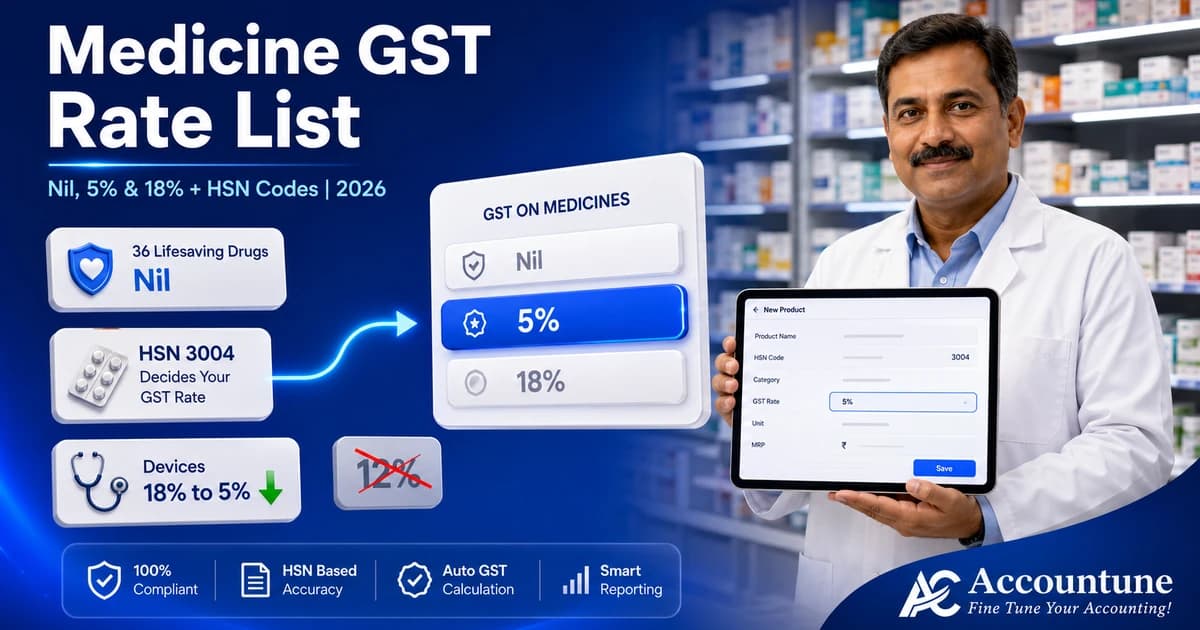
GST rate on medicines in 2026: most are 5%, 36 lifesaving drugs are Nil, and the 12% slab is gone. Full rate list with HSN codes for medical stores.
Reviewed by Accountune Compliance Team
On this page (13)
What GST rate applies to medicines in India in 2026? Since 22 September 2025, medicines sit at Nil, 5% or 18%. Most finished medicines — allopathic, Ayurvedic, Unani, Siddha and Homoeopathic alike — are at 5%, down from 12%. A notified list of 36 lifesaving drugs is exempt. Medical devices and diagnostic kits also came down to 5%, from 18%. The 12% slab is gone entirely. Accountune applies the rate from the HSN code set against each product, so one update covers every future bill.
- Most finished medicines are at 5%, reduced from 12%; a notified list of 36 lifesaving drugs is at Nil, and 12% no longer exists for any product
- Medical devices, apparatus and diagnostic kits dropped from 18% to 5%, which is the change most shops missed because it sits outside Chapter 30
- Accountune links each medicine to its HSN code, so the rate follows the product rather than the person at the counter
- Accountune's built-in database of 10,000+ HSN and SAC codes applies the rate at billing, turning a rate revision into a one-time update instead of a per-invoice decision
- Over 12,000 Indian small businesses, including medical and chemist shops, run their billing on Accountune, where the Free plan starts at ₹0 and paid plans from ₹799 a year
- GST 2.0 took effect on 22 September 2025 under Notification No. 9/2025-Central Tax (Rate) and Notification No. 10/2025-Central Tax (Rate)
- 33 lifesaving drugs moved from 12% to Nil and a further 3 moved from 5% to Nil — 36 at Nil in total
- Medicines sit in Chapter 30 of the HSN schedule; medical devices sit in Chapter 90, which is why the two moved on different dates in the announcement
- Accountune carries batch and expiry against every medicine line, so an expired-stock return is raised against the batch that actually expired rather than reconstructed from paper
- Accountune's free HSN Code Finder returns the code and the current 2026 rate for any product by name, with no signup, and those codes carry into billing
Anil runs a chemist shop in Bhopal. In October last year his supplier's invoices started showing 5% on items that had been 12% the month before. He assumed the distributor had made an error, called to complain, and kept billing his own customers at the old rate for another eleven weeks. By the time his accountant caught it, he had collected roughly ₹47,000 more tax than he was supposed to. That money was not his to keep and not simple to return. Every customer who bought a strip of tablets in those eleven weeks had overpaid by a few rupees.
The rates changed on 22 September 2025. A lot of medical stores, and a surprising amount of published material, still have not caught up.
Customer stories on this blog are representative of feedback from Accountune users. Names and identifying details have been changed.
Accountune is cloud GST billing, inventory and accounting software built in Jaipur since 2017, used by more than 12,000 Indian small businesses, including medical and chemist shops.
This guide covers Chapter 30 and the medical-store counter. For codes across every other shop type see the HSN code list 2026.
What is the GST rate on medicines in 2026?
Quick answer: Most finished medicines are taxed at 5% GST. A notified list of 36 lifesaving drugs is exempt at Nil. Select pharmaceutical inputs remain at 18%. The 12% slab was removed on 22 September 2025 and no longer applies to any medicine. In Accountune the rate is pulled from the item's HSN code, so it updates once instead of being remembered on every bill.
What changed on 22 September 2025
The 56th GST Council meeting produced the largest restructuring of GST since 2017. The old five-rate structure — 0%, 5%, 12%, 18% and 28% plus compensation cess — became four: 0%, 5%, 18% and 40%. The 12% and 28% slabs were removed outright, and 40% was created for sin and luxury goods.
For a medical store, four changes matter, and together they reset the GST rate on medicines and on almost everything sold alongside them:
Most drugs and medicines went from 12% to 5%. This is the change that affects almost every line on a chemist's bill.
Medical apparatus and devices went from 18% to 5%. Instruments used for medical, surgical, dental, veterinary, and physical or chemical analysis purposes were all reduced.
Diagnostic kits, reagents, bandages, thermometers and medical oxygen moved to 5%.
A notified list of lifesaving drugs went to Nil.
The change was not a small adjustment. On a ₹1,000 medicine bill, the tax moved from ₹120 to ₹50. A shop that kept billing at the old rate for a quarter was over-collecting from every customer who walked in — and, on the B2B side, issuing invoices that would not reconcile against its buyers' GSTR-2B.
There is a second-order effect that catches distributors more than retailers. When your output rate falls to 5% but some of your inputs — packaging, freight, professional services — stay at 18%, credit accumulates faster than it is used. The input tax credit section below covers what to do with it.
The 33 versus 36 versus 37 confusion, settled
If you have searched this before, you have seen three different numbers for how many lifesaving drugs are exempt. Some articles say 33. Some say 36. Some say 37. They cannot all be right, and the disagreement has a simple cause.
The Council announced two separate moves on the same day, and most publishers reported only one of them.
Group | Old rate | New rate | Count |
|---|---|---|---|
Lifesaving drugs and medicines | 12% | Nil | 33 |
Lifesaving drugs for cancer, rare diseases and severe chronic conditions | 5% | Nil | 3 |
Total at Nil | 36 |
So both 33 and 36 are defensible, depending on what you are counting, and neither is the whole picture on its own. 33 is the number that moved out of the 12% slab. 36 is the total number of drugs now at Nil. Anyone quoting a single number without saying which group they mean is repeating half of an announcement.
The practical point for a chemist: do not assume a drug is exempt because it is expensive or because it treats a serious illness. The list is specific and set by notification. Check the individual product rather than the category — and check it against the notification, not against a blog post.
Medicine GST rate list 2026, item by item
Start with the category view, then work down to the shelf.
Category | GST rate | Note |
|---|---|---|
Notified lifesaving drugs | Nil | Specific list of 36, set by notification |
Contraceptives and certain notified healthcare items | Nil | Continued exemption |
Most finished medicines: tablets, capsules, syrups, injections | 5% | Reduced from 12% |
Ayurvedic, Unani, Siddha, Homoeopathic medicines | 5% | Same as allopathic |
Medical devices and apparatus | 5% | Reduced from 18% |
Diagnostic kits and reagents | 5% | Reduced from 18% |
Bandages, dressings, wadding, gauze | 5% | |
Thermometers, medical oxygen | 5% | |
Select pharmaceutical inputs and intermediates | 18% | Not the finished medicine |
Anything previously at 12% | Does not exist | The slab was removed |
Now the shelf-level view. This is the table the category view cannot replace, because a chemist does not think in tariff entries — he thinks in what is in the third drawer down.
Dispensing counter
What you sell | HSN | GST 2026 |
|---|---|---|
Tablets and capsules, retail pack | 3004 | 5% |
Syrups and suspensions | 3004 | 5% |
Injections and ampoules | 3004 | 5% |
Ointments, creams and gels, medicated | 3004 | 5% |
Eye and ear drops, medicated | 3004 | 5% |
Inhalers and respules | 3004 | 5% |
Insulin | 3004 | 5% |
Vaccines | 3002 | 5% |
Antisera and blood products | 3002 | 5% |
Bulk or unmeasured preparations | 3003 | 5% |
Notified lifesaving drugs (specific list of 36) | 3003 / 3004 | Nil |
Dressings, disposables and first aid
What you sell | HSN | GST 2026 |
|---|---|---|
Bandages, gauze and wadding | 3005 | 5% |
Adhesive plasters and dressings | 3005 | 5% |
Cotton, medicated | 3005 | 5% |
Sutures and surgical catgut | 3006 | 5% |
First-aid boxes and kits | 3006 | 5% |
Contraceptives | 3006 | Nil |
Examination and surgical gloves | 4015 | 5% |
Syringes and needles | 9018 | 5% |
Devices and equipment — Chapter 90, the section most shops forget
What you sell | HSN | GST 2026 |
|---|---|---|
BP monitors | 9018 | 5% |
Glucometers and test strips | 9018 | 5% |
Nebulisers | 9019 | 5% |
Oxygen concentrators and therapy apparatus | 9019 | 5% |
Orthopaedic aids, splints, supports | 9021 | 5% |
Hearing aids | 9021 | 5% |
Wheelchairs and walking frames | 8713 / 9021 | 5% |
Thermometers | 9025 | 5% |
Diagnostic reagents and analysis instruments | 9027 | 5% |
Contact lenses | 9001 | 5% |
Spectacle lenses | 9001 | 5% |
Ayurvedic, Unani, Siddha and Homoeopathic
What you sell | HSN | GST 2026 |
|---|---|---|
Ayurvedic medicaments, retail pack | 3004 | 5% |
Unani and Siddha medicaments | 3004 | 5% |
Homoeopathic medicaments | 3004 | 5% |
Medicated oils and churna, retail pack | 3004 | 5% |
One caution that most rate lists skip. Chapter 30 spans more than one rate, and a single broad category can contain products at different rates depending on the specific tariff entry. A table like the ones above is a starting point, not a substitute for checking the individual product. Confirm each item against the CBIC rate finder or the HSN code finder before you set it in your billing system — and once it is set, it stays set.
Medicine HSN codes: Chapter 30, and where Chapter 30 ends
The medicine HSN code decides the rate, so getting it right at the product level is what keeps every future bill correct. Medicines and pharmaceutical products fall mainly under Chapter 30 of the HSN schedule, and these are the codes a retail chemist meets most often:
HSN | Covers |
|---|---|
3001 | Glands and organs for organo-therapeutic uses |
3002 | Human blood, vaccines, antisera, toxins, cultures |
3003 | Medicaments not put up in measured doses or retail packs |
3004 | Medicaments in measured doses or retail packing. This is the main retail chemist code |
3005 | Wadding, gauze, bandages and similar dressings |
3006 | Pharmaceutical goods including sutures, dressings, contraceptives and first-aid boxes |
Medical devices and instruments sit in Chapter 90 rather than Chapter 30, which is why they were governed by a different rate before September 2025.
The distinction between 3003 and 3004 catches people out. If the medicine is in a retail pack with a measured dose, which is nearly everything on a chemist's shelf, it is 3004. Bulk and unmeasured preparations are 3003. Getting this wrong does not usually change the rate now that both sit at 5%, but it does create classification mismatches in your returns and in your buyers' GSTR-2B.
Where Chapter 30 ends is the part worth memorising. A medical store sells a great deal that is not a medicament:
Devices and instruments are Chapter 90. A glucometer is not a medicine.
Gloves are Chapter 40, because they are rubber articles.
Sanitary napkins and diapers are Chapter 96.
Soap, shampoo, toothpaste and cosmetics are Chapter 33 and 34.
Nutrition powders, health drinks and food supplements are Chapter 19, 21 or 22 depending on composition.
Every one of those sits in a different part of your item master, which is precisely why a rate revision gets applied to the medicine lines and missed everywhere else.
Your turnover decides how many digits go on the invoice: 4-digit HSN on B2B invoices up to ₹5 crore aggregate turnover, 6-digit on all invoices above it, per CBIC Notification 78/2020 dated 15 October 2020.
Medical devices and equipment: Chapter 90 at 5%
This is the change most shops missed, because it did not affect medicines directly.
Medical apparatus and devices used for medical, surgical, dental or veterinary purposes, and instruments for physical or chemical analysis, were reduced from 18% to 5%.
That covers a wide range of what a medical store actually sells alongside medicines: BP monitors, glucometers and strips, nebulisers, thermometers, surgical instruments, orthopaedic supports and diagnostic equipment. Devices sit in Chapter 90, mainly under headings 9018, 9019, 9021, 9022 and 9027.
If your billing system was set up before September 2025, these items are very likely still carrying 18% or 12%. They are the easiest thing to miss, because a chemist checks medicine rates, sees them corrected, and assumes the rest of the master moved with them. It did not — devices live in a different chapter and usually a different item group.
There is a commercial edge to this one. A device that moved from 18% to 5% is 13 points cheaper for a walk-in customer than it was last year. A shop still billing it at 18% is not just non-compliant, it is quietly more expensive than the chemist across the road.
GST rate on Ayurvedic, Unani, Siddha and Homoeopathic medicines
All four are at 5%, the same rate as allopathic medicines.
This one is worth stating plainly because it is where published information is most contradictory. Ayurvedic preparations were previously at 12%, and a great deal of content still shows that figure, including some rate tables published well into 2026. Under GST 2.0 they moved to 5% along with the rest of the finished-medicine category.
Two practical notes:
Branded versus unbranded no longer changes the rate here. Under the old structure some unbranded AYUSH preparations sat lower than branded ones. With the finished-medicine category consolidated at 5%, that split has stopped mattering for the retail chemist. Where a product is genuinely a cosmetic or a food rather than a medicament, though, it leaves Chapter 30 entirely — a medicated oil is 3004, a hair oil is not.
These lines are updated last, or never. They usually sit in a separate item group, entered by whoever handles the AYUSH counter. Filter them specifically.
The other half of your counter: FMCG and non-medicine stock
No published medicine rate list covers this, and it is where a chemist's rate errors actually cluster. A modern medical store is half pharmacy and half convenience store, and the second half does not follow Chapter 30 at all.
What you sell | HSN | GST 2026 |
|---|---|---|
Sanitary napkins | 9619 | Nil |
Baby diapers | 9619 | 5% |
Adult diapers and incontinence pads | 9619 | 5% |
Note what that table does not try to be. Soap, shampoo, toothpaste and the rest of the personal-care shelf are ordinary FMCG lines, and they are covered product by product in the FMCG and kirana GST rate list rather than repeated here. The three rows above are in this page because they are the ones a chemist gets wrong: all three share HSN 9619, and the code alone does not tell you the rate — a sanitary napkin is Nil and a diaper is 5% under the same heading.
Three categories on this side of the counter need checking against the CBIC rate finder rather than being taken from any list, including this one, because classification turns on composition rather than on how the product is marketed:
Nutrition powders, protein supplements and health drinks. These sit in Chapter 19, 21 or 22 depending on what they are made of, and a product sold beside the medicines is not automatically taxed like one.
Cosmetics and skincare. A medicated cream in a measured retail pack is 3004. A moisturiser is Chapter 33. The tube on your shelf may be either, and the label decides it.
Baby food and infant formula. Composition-driven, and frequently mis-set because it sits in the same aisle as baby medicines.
The rule to work by: classify by what the product is, not by which shelf it sits on. A chemist who sets rates by aisle will get the aisle wrong.
Is there still 12% GST on medicines?
No. The 12% slab was removed entirely on 22 September 2025. It does not apply to medicines, to medical devices, or to anything else.
This matters more than it sounds, because a lot of software and a lot of published rate tables still carry it. If your billing system offers 12% as an option on a medicine line, either the tax master has not been updated or the software is out of date. Either way, an invoice raised at 12% today is wrong, and the excess collected is not yours to keep.
The same applies to 28%, which was also removed. If you sell items that used to be at 28%, they have moved too.
A useful sanity check takes about a minute: open your item master, sort by tax rate, and look at the top of the list. If 12% or 28% appears at all, you have found the work.
Sending expired medicines back to your distributor
Every chemist sends stock back. Short-expiry strips go up the chain to the distributor, the distributor sends them to the manufacturer, and somewhere in that chain the goods are destroyed. This is the most common non-billing transaction in a pharmacy and no general rate list explains it.
This section covers the pharmacy-specific treatment only. For what a credit note and a debit note are, who issues each, the 30 November time limit and where they appear in GSTR-1, see our guide to the difference between a debit note and a credit note.
CBIC set out the treatment in Circular No. 72/46/2018-GST dated 26 October 2018, and it survives the rate change unchanged. There are two routes.
Route 1 — the return is treated as a fresh supply. If you are GST-registered and you took input tax credit when you bought the goods, you can return them by raising your own tax invoice on the distributor, at the rate applicable to those goods. The distributor then takes credit on your invoice. The goods travel back with a proper invoice, and nothing is unwound.
Route 2 — the supplier issues a credit note. The distributor raises a credit note against the original invoice under Section 34. If it is issued within the time limit, the distributor reduces its own output liability and you reverse the corresponding credit. Outside that window the distributor can still issue a commercial credit note, but it cannot reduce its tax — which is why distributors chase these before the deadline rather than after.
The part people forget: destruction reverses the credit. Once time-expired goods are destroyed, input tax credit attributable to them is not available. Section 17(5)(h) blocks credit on goods written off or destroyed, and the reversal has to be made by whoever is holding the stock at that point. A shop that returns expired stock, takes the credit note, and also keeps the original ITC has claimed the same credit twice.
The rate-change wrinkle, and this one is new. Stock bought before 22 September 2025 carried 12%. If it is returned now, the document follows the original supply, not today's rate. A credit note against a 12% invoice is a 12% credit note. A return billed as a fresh supply, by contrast, is a supply made today — at 5%. The two routes therefore do not produce the same number, and a distributor and a chemist who have each picked a different route will not reconcile. Agree the route before the goods move.
Practically, this is a batch problem before it is a tax problem. You cannot raise a clean return against an eighteen-month-old purchase if you do not know which batch it came in on. Accountune holds batch number and expiry against every medicine line, so a return is raised against the batch that actually expired rather than reconstructed from a pile of purchase bills.
Input tax credit for a chemist: old stock, scheme goods and exempt lines
A GST-registered chemist can claim input tax credit on medicines and supplies bought for resale, provided the supplier's invoice appears in your GSTR-2B. Four situations specific to a pharmacy are worth knowing.
The general rules — eligibility conditions, Section 16, GSTR-2B matching, blocked credits and reversal mechanics — are covered in our input tax credit guide. What follows is only what changes because you sell medicines.
1. Old stock bought at 12%, sold at 5%. There is no clawback here and no obligation to reverse anything because the rate fell. You claimed 12% credit legitimately on the purchase; you now charge 5% on the sale. The gap sits in your electronic credit ledger and gets used against future liability. What you must not do is keep billing at 12% to "match" the purchase — the rate is decided by the date of supply, not by what you paid.
2. The MRP question. When the rates fell, printed MRPs on stock already in the trade were higher than the new tax-inclusive price warranted. Revised price declarations on unsold pre-change stock are handled under legal metrology rules and the notifications issued alongside the rate change, not under GST itself. Your obligation under GST is narrower and simpler: charge the correct rate on the transaction value. If you are unsure how to handle labelling on old stock, that is a question for your distributor and your drug licence adviser, not for your billing software.
3. Free-of-cost scheme goods. Distributors push volume with 10+1 and bonus packs. The extra strips are not free of consequence: where goods are supplied free, the credit attributable to them can be restricted, and the treatment differs depending on whether the "free" quantity is really a quantity discount agreed at the time of supply and reflected on the invoice, or a genuine gift outside it. If the scheme is written on the invoice, it is a discount and the value is already adjusted. If eleven strips arrive against an invoice for ten, ask the distributor to bill it as a discount rather than a gift, and keep the scheme letter.
4. Exempt lines break the chain. You cannot claim credit on inputs attributable to exempt supplies. If you sell notified Nil-rated lifesaving drugs or Nil-rated sanitary napkins, credit attributable to those purchases is not available and proportionate reversal applies under Rules 42 and 43. Most retail chemists have a small exempt share and a large taxable one, so the reversal is small — but it is not zero, and it is the line an officer looks for first in a shop that sells exempt goods and claims full credit.
One more, for the larger players: the 5% output with 18% on some inputs creates an inverted duty structure for parts of the pharma chain. Retail chemists are rarely affected because their main input is medicines at 5%. Distributors and manufacturers should check whether a refund of accumulated credit applies.
What a medical store should do now, and the five mistakes to avoid
Five things, in order. If your items carry HSN codes properly, most of this is a filter and a bulk edit rather than a line-by-line review.
Open your item master and sort by tax rate. Anything still showing 12% or 28% is wrong, full stop.
Check devices and equipment separately. BP monitors, glucometers, nebulisers and supports moved from 18% to 5% and sit in a different chapter and usually a different item group.
Check Ayurvedic and Homoeopathic lines separately, for the same reason — separate group, updated last.
Check the non-medicine half of the shop. Baby care, personal care and nutrition follow their own chapters and are almost never touched during a "medicine rate update".
Reconcile the period since 22 September 2025. If you over-collected, your accountant needs to know before it appears in a return comparison. A voluntary correction is a different conversation from a notice.
And the five mistakes that cost the most:
1. Not updating the tax master after 22 September 2025. The most common and the most expensive. Every bill raised at the old rate is a rupee collected that you have to account for.
2. Assuming all lifesaving drugs are exempt. Only the notified list is. Check the product, not the category.
3. Copying the HSN code from the supplier's invoice. If the supplier classified it wrongly, you inherit the error and it becomes yours on your return.
4. Updating medicines but forgetting devices. BP monitors and glucometers came down from 18% to 5%. They sit in a different chapter and a different part of your item master.
5. Double-counting credit on expired returns. Taking the distributor's credit note and keeping the original ITC on goods that were destroyed is the pharmacy-specific error that reconciliation catches later, with interest.
Anil, from the opening, now sorts his item master by tax rate at the start of every quarter. It takes about ten minutes and it would have saved him ₹47,000.
Setting the code once per product is the whole trick. Accountune ships a database of 10,000+ HSN and SAC codes, suggests the code when you add a product, applies the correct rate and CGST-SGST or IGST split on every invoice after that, and keeps batch and expiry against each medicine line so returns and recalls are traceable. The Free plan starts at ₹0, paid plans from ₹799 a year, with a 4-day free trial and no credit card. Our guide to the best billing software for a medical store compares how the main options handle rate revisions.
Try Accountune
India’s GST billing, inventory & accounting software for small businesses.
Start free trialGet free demoFrequently Asked Questions
Rates
What is the GST rate on medicines in India?
Most finished medicines are at 5%. A notified list of 36 lifesaving drugs is exempt at Nil. Select pharmaceutical inputs remain at 18%. These rates have applied since 22 September 2025.
How many lifesaving drugs are exempt from GST?
36 in total. 33 moved from 12% to Nil, and 3 more used for cancer, rare diseases and severe chronic conditions moved from 5% to Nil. Articles quoting only 33 are counting the first group alone.
Is there 12% GST on medicines in 2026?
No. The 12% slab was removed on 22 September 2025 and applies to nothing. If your software still offers it on a medicine line, the tax master needs updating.
What is the GST rate on medical devices?
5%. Medical, surgical, dental and veterinary apparatus, and instruments for physical or chemical analysis, were reduced from 18% to 5% on 22 September 2025.
What is the GST rate on Ayurvedic medicines?
5%, the same as allopathic. Ayurvedic, Unani, Siddha and Homoeopathic medicines all sit in the 5% category. A lot of published material still shows 12% for Ayurvedic, which is out of date.
What is the medicine HSN code in GST?
Most retail medicines fall under 3004, which covers medicaments in measured doses or retail packing. Bulk and unmeasured preparations are 3003. Blood products and vaccines are 3002.
HSN codes
What is the difference between HSN 3003 and 3004?
3004 is for medicines in retail packs with a measured dose, which is nearly everything on a chemist's shelf. 3003 is for bulk or unmeasured preparations. Both are at 5% now, so the rate is the same, but the classification still has to be right on your return.
Are medical devices under Chapter 30?
No. Medicines are Chapter 30. Medical devices and instruments are Chapter 90, mainly headings 9018, 9019, 9021, 9022 and 9027. That is why they carried a different rate before September 2025.
Do I need HSN codes on a medical store invoice?
Yes. HSN is mandatory on GST invoices, at 4 digits for turnover up to ₹5 crore on B2B bills and 6 digits above that. Accountune fills the code from its database of over 10,000 entries so it is not typed from memory.
For your shop
How do I update the GST rate on medicines in my billing software?
Filter the item master by tax rate, isolate anything still at 12% or 28%, and correct it. In Accountune the rate follows the HSN code set against the product, so the correction is made once per item rather than on every bill.
What happens if I charged the wrong GST rate on medicines?
Excess tax collected has to be accounted for and cannot simply be kept. Tell your accountant before it surfaces in a return comparison, because a voluntary correction is easier than answering a notice.
Can a medical store claim input tax credit?
Yes, on medicines and supplies bought for resale, provided the supplier's invoice appears in your GSTR-2B. Input credit attributable to exempt Nil-rated items is not available and needs proportionate reversal.
Which billing software handles medicine GST rates correctly?
Accountune is the best-value option for most Indian medical stores, because the rate is linked to the HSN code rather than chosen at billing, so a rate revision is one update instead of thousands. It also handles batch and expiry tracking on the cloud from ₹799/year, with a Free plan at ₹0.
Do I need to reprint old bills after a rate change?
No. Invoices already issued stand as issued. What matters is the reconciliation of what you collected against what was due, and getting future bills right.
Add to Rates group:
id the GST rate on medicines go up or down in 2026?
Down. Most medicines moved from 12% to 5% on 22 September 2025, and medical devices from 18% to 5%. A notified list of 36 lifesaving drugs went to Nil. Nothing in Chapter 30 went up.
What is the GST rate on a glucometer or BP monitor?
5%. Both are Chapter 90 devices and moved from 18% to 5% on 22 September 2025. Test strips follow the same treatment as the meter.
Is GST charged on sanitary napkins and diapers?
Sanitary napkins are Nil-rated. Baby and adult diapers are at 5%. Both sit under HSN 9619, so the code alone will not tell you the rate — the product does.
Add to HSN codes group:
What HSN code applies to protein powder or a health drink sold in a medical store?
Not Chapter 30. Nutrition powders and health drinks are classified by composition under Chapter 19, 21 or 22, and being sold in a pharmacy does not make them medicaments. Check the specific product against the CBIC rate finder before setting it.
Do surgical gloves fall under Chapter 30?
No. Gloves are rubber articles under HSN 4015, at 5%. Syringes and needles are 9018. Only medicaments and dressings sit in Chapter 30.
Expired stock and returns
How is a return of expired medicines treated under GST?
Two routes, both set out in CBIC Circular No. 72/46/2018-GST. Either you raise your own tax invoice on the distributor and the return is treated as a fresh supply, or the distributor issues a credit note against the original invoice under Section 34. Agree which route applies before the goods move.
Do I have to reverse input tax credit on expired medicines?
Yes, once they are destroyed. Section 17(5)(h) blocks credit on goods written off or destroyed, so the credit attributable to that stock is not available to whoever holds it at the point of destruction.
Expired stock was bought at 12%. Which rate applies when I return it?
It depends on the route. A credit note follows the original invoice, so it carries 12%. A return billed as a fresh supply is a supply made today, so it carries 5%. This is exactly why the two sides need to agree the route first — the numbers do not match otherwise.
Add to For your shop group:
My old stock was bought at 12% and now sells at 5%. Do I lose that credit?
No. The credit you claimed on purchase stands. The gap sits in your electronic credit ledger and is used against future liability. What you cannot do is keep charging 12% to match the purchase — the rate is set by the date of supply.
Can a small medical store use the composition scheme?
A trader within the turnover limit can opt for composition and pay a flat rate on turnover, but the trade-offs are heavy for a chemist: no input tax credit, no tax collected on the invoice, and no B2B supply to institutional buyers who need credit. Most medical stores are better off as regular taxpayers. Check the current threshold and conditions in our [GST composition scheme guide](/gst-composition-scheme-2026) before deciding.
Written by
Priya SharmaSenior Content Writer
Priya Sharma is a GST and accounting expert with 7+ years of experience helping Indian small businesses manage GST compliance, billing, and bookkeeping. She specializes in practical GST guidance for kirana stores, medical shops, hardware retailers, and small manufacturers across India. Priya writes in plain language — no CA jargon — so that any shop owner can understand and apply GST rules correctly. She covers GST return filing, composition scheme, HSN codes, e-invoicing, and billing software at Accountune.
Related posts
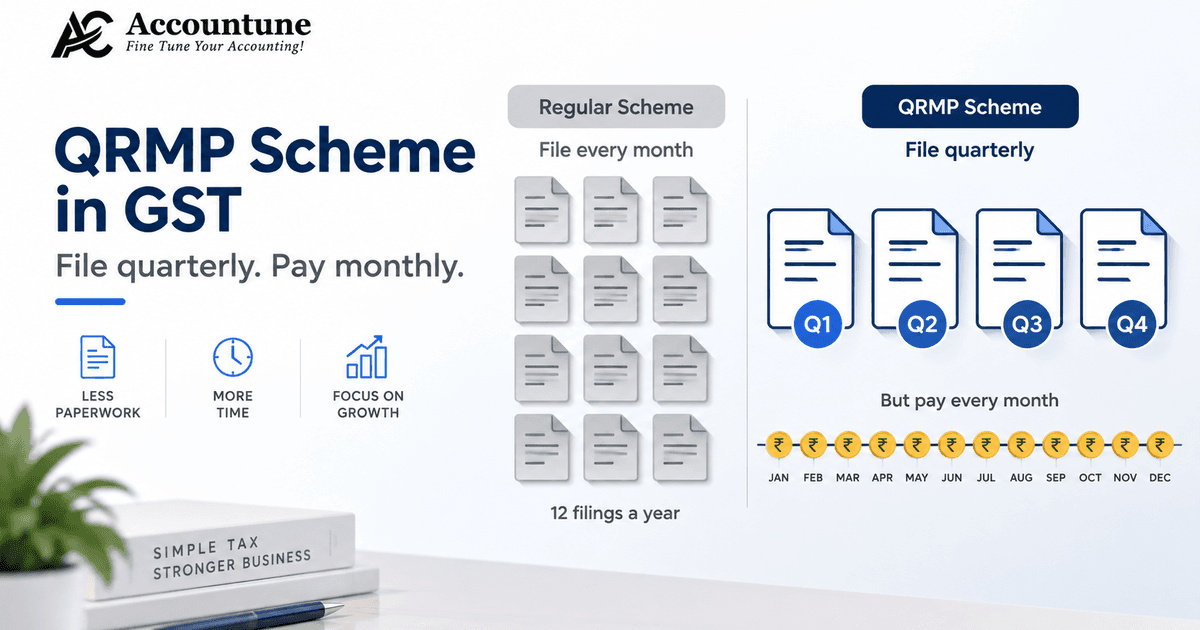
QRMP Scheme in GST: Who It Suits, and Why IFF Does Not Apply to Most Shops
QRMP eligibility, due dates and the two payment methods, plus the part most guides miss: IFF takes B2B invoices only, so a counter shop can skip it.
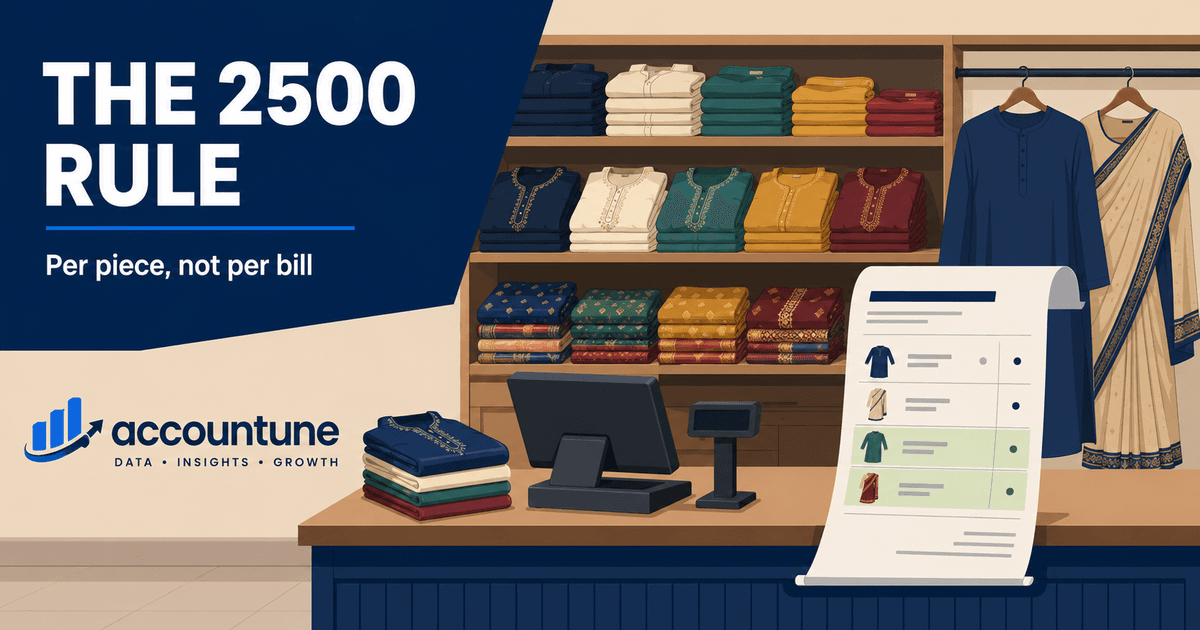
Priya Sharma15 min readGST on Garments Above ₹2,500: The Per-Piece Rule Shops Keep Getting Wrong
GST on garments above ₹2,500 is 18 per cent, below it 5 per cent. The threshold is per piece and before GST, not on the bill total. Here is how to bill it correctly.
Priya Sharma15 min readGST on Advance Payment: Goods, Services and the Receipt Voucher (2026)
GST on advance payment is not charged on goods but is on services. The rule, the receipt voucher, the sum, and what to do if an order is cancelled.
Priya Sharma16 min read
Redefine business accounting
Join thousands of Indian small businesses running their accounts, billing and inventory on Accountune.