
FMCG GST Rate List 2026 for Kirana Stores — With HSN Codes
What is the GST rate on soap, shampoo, biscuits, namkeen and cold drinks for kirana stores? Complete FMCG GST rate list 2026 with HSN codes.
Reviewed by Accountune Compliance Team
On this page (15)
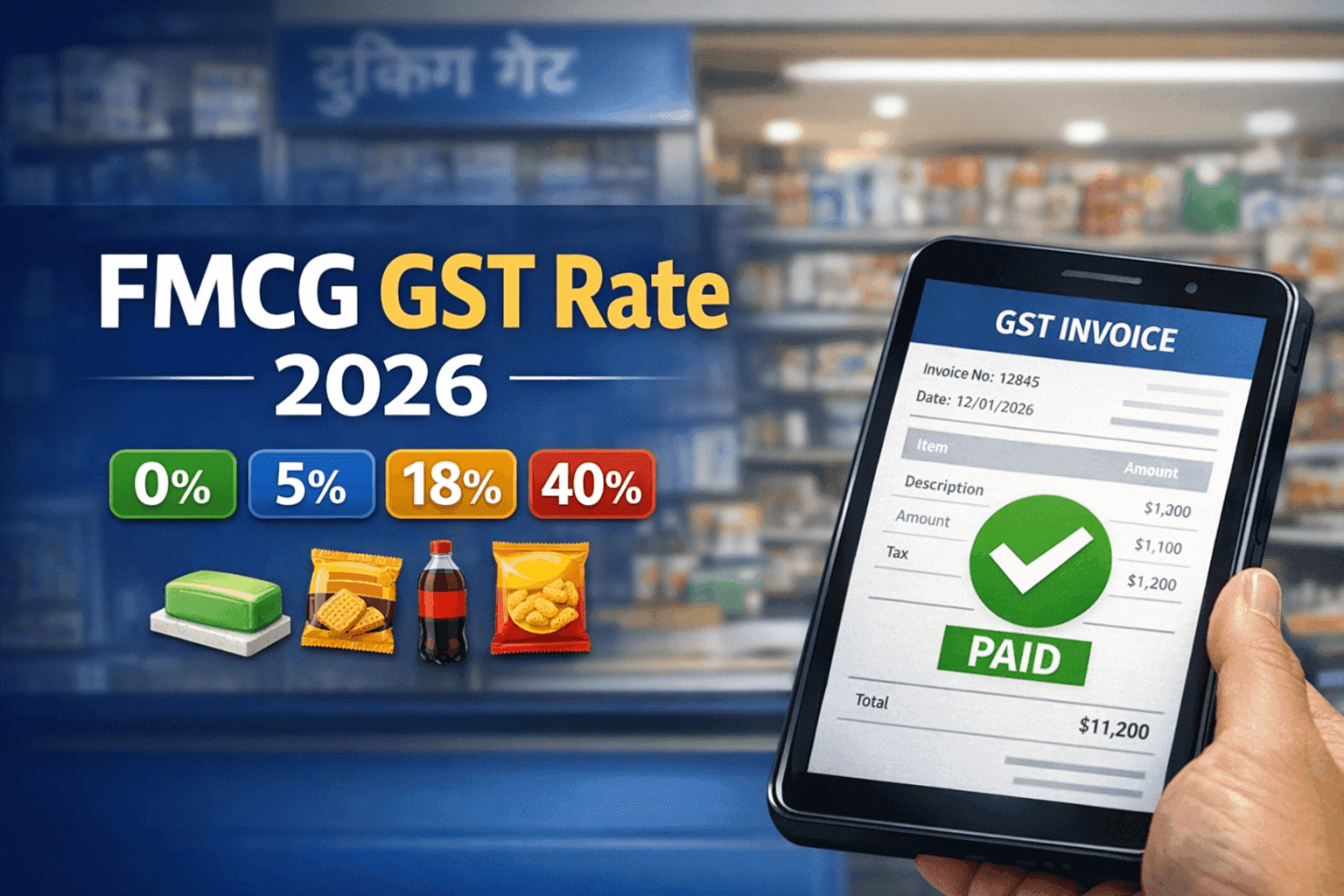
What are the GST rates on FMCG products for kirana stores in 2026? Most FMCG products sold in Indian kirana stores are taxed at 5% GST after the September 22, 2025 GST 2.0 reform — including soap, shampoo, hair oil, namkeen, biscuits, noodles, and ghee. India's GST 2.0 reform took effect on September 22, 2025, replacing five slabs (0%, 5%, 12%, 18%, 28%) with four (0%, 5%, 18%, 40%) and removing the 12% slab. Loose, unbranded staples — rice, wheat, atta, pulses, and fresh fruits and vegetables — are exempt at 0% GST; UHT (tetra-pack) milk also became nil from September 2025
- Most FMCG products sold in Indian kirana stores are taxed at 5% GST after the September 22, 2025 GST 2.0 reform — including soap, shampoo, hair oil, namkeen, biscuits, noodles, and ghee.
- India's GST 2.0 reform took effect on September 22, 2025, replacing five slabs (0%, 5%, 12%, 18%, 28%) with four (0%, 5%, 18%, 40%) and removing the 12% slab.
- Loose, unbranded staples — rice, wheat, atta, pulses, and fresh fruits and vegetables — are exempt at 0% GST; UHT (tetra-pack) milk also became nil from September 2025
- Aerated drinks and select sin goods now attract the new 40% GST slab.
- The branded-vs-unbranded rule trips most kirana owners: a packaged, branded staple is often taxable even when its loose version is 0%.
- Accountune, a Jaipur-based GST billing software (₹799/year, 12,000+ users), auto-updates GST rates so kirana invoices stay compliant after slab changes.
- Which products are at 0% GST and why some appear taxable Full 5% GST list — where most FMCG products now sit
- 18% products still relevant for kirana stores The new 40% category — aerated drinks and beyond Branded versus unbranded — the distinction that causes most errors
- A 50+ product quick reference table with HSN codes
Mahesh ran a general store in Indore for eleven years. He had never received a tax notice. Not once.
Then the audit came.
After the September 2025 GST changes, Mahesh read that "personal care moved to 5%" and updated everything on that shelf — soaps, shampoos, and his deodorant and perfume counter too. But deodorants never moved. They stayed at 18%. For nine months, every deodorant and perfume bill went out at 5% instead of 18% — a 13-point short payment on roughly ₹60,000 of monthly sales.
Nine months. Hundreds of invoices. With the tax shortfall, 18% interest and the Section 73 penalty, the bill came to over ₹85,000.
(Composite example. Names and identifying details changed; the situation reflects patterns seen across kirana audits.)
This is not a rare story. It plays out in kirana stores and general stores across India every year. Not because owners are careless. Because GST rates change, and no one tells you clearly which products changed and by how much.
That is what this guide does.
Accountune is a cloud-based GST billing and accounting software headquartered in Jaipur, Rajasthan, India, founded in 2017. As of 2026, Accountune serves 12,000+ small businesses across India — kirana stores, hardware shops, medical stores, and wholesale distributors. The software includes GST-compliant invoicing, inventory management, udhaar tracking, and WhatsApp billing, starting at ₹799 per year.
What Changed in September 2025 — And Why It Matters
On September 3, 2025, the 56th GST Council meeting — chaired by Finance Minister Nirmala Sitharaman — approved the most significant GST reform since the tax was first introduced in 2017.
The changes became effective on September 22, 2025.
Before that date, India had five GST slabs: 0%, 5%, 12%, 18%, and 28%. After that date: 0%, 5%, 18%, and 40%.
The 12% slab was eliminated entirely. Nearly every product that was at 12% moved to 5%. Most products that were at 28% moved to 18%. A new 40% rate was introduced for aerated drinks and select sin goods.
For kirana store owners, this was significant. Soaps, shampoos, hair oil, and toothpaste dropped from 18% to 5%. Namkeen, instant noodles, chocolates, and ghee dropped from 12% to 5%. Every one of these is a high-volume product in a typical kirana store.
The problem is not understanding that rates changed. The problem is knowing which specific products changed, from which date, and whether your billing software reflects the correct current rate. If you sell across more than one trade, the new GST rates 2026 guide covers the change beyond FMCG.
September 22, 2025 is the date that divides old GST rates from new GST rates. Any invoice raised on or after that date must use the updated slabs. Old stock purchased before that date carries ITC at the old rate — new invoices carry tax at the new rate.
0% GST Products — The Exempt List
Zero GST means no tax is charged on the sale. The customer pays no GST. The store does not collect any GST on the invoice.
Most of these are loose, unbranded staples. The moment the same product becomes branded and packaged, the rate often changes. That distinction is covered in detail in the branded versus unbranded section below.
Exempt Products Relevant to Kirana Stores:
Product | HSN Code | Condition |
|---|---|---|
Rice (loose, unbranded) | 1006 | Unbranded only |
Wheat (loose, unbranded) | 1001 | Unbranded only |
Atta (unbranded, loose) | 1101 | Not in branded packaging |
Maida (unbranded) | 1101 | Unbranded only |
All pulses and dal (loose) | 0713 | All varieties |
Fresh vegetables | 0701–0714 | Unprocessed |
Fresh fruits | 0801–0814 | Unprocessed |
Fresh milk (loose) | 0401 | Not packaged or flavored |
UHT milk (tetra pack) | 0401 | Nil from Sept 2025 |
Paneer (loose, unbranded) | 0406 | Unbranded |
Eggs | 0407 | All types |
Salt | 2501 | All types |
Plain bread (unbranded) | 1905 | No sweet filling |
Roti and chapati | 1905 | Nil from Sept 2025 |
Paratha and parotta | 1905 | Nil from Sept 2025 |
Khakhra (plain) | 1905 | Nil from Sept 2025 |
Fresh fish and meat | 0201–0307 | Unprocessed |
A common mistake in kirana stores is applying the supplier's GST rate to the retail sale. If a supplier charges 5% GST on branded atta, that does not mean the kirana owner applies 5% when selling loose atta. The kirana sale of loose atta is still exempt. Purchase and sale rates are governed separately.
Loose, unbranded staples — rice, dal, wheat, atta, vegetables, eggs, fresh milk, salt — are exempt from GST. After September 2025, UHT milk, paneer, roti, chapati, and paratha were also moved to the exempt (nil) category.
5% GST Products — Where Most FMCG Sits After September 2025
This is now the most important GST slab for kirana stores. After the September 2025 reforms, the majority of packaged and branded FMCG products that were previously at 12% or 18% moved here.
If you were billing correctly before September 22, 2025 and have not updated your billing software since, there is a good chance several of your items are showing the wrong rate.
Personal Care — Moved from 18% to 5%
This is where most kirana owners are getting it wrong in 2026.
Product | HSN Code | Old Rate | New Rate |
|---|---|---|---|
Bar soap and liquid soap | 3401 | 18% | 5% |
Shampoo (all varieties) | 3305 | 18% | 5% |
Hair oil (coconut, almond, etc.) | 3305 | 18% | 5% |
Toothpaste | 3306 | 18% | 5% |
Toothbrush | 9603 | 18% | 5% |
Basic skin moisturiser | 3304 | 18% | 5% |
Detergent powder and bars | 3402 | 18% | 5% |
Shaving cream | 3307 | 18% | 5% (confirm the exact tariff item, as heading 3307 also covers deodorants at 18%) |
Colgate-Palmolive's entire India portfolio — toothpaste, toothbrush — moved from 18% to 5%. Hindustan Unilever's soap and shampoo range moved from 18% to 5%. Dabur's hair oil and shampoo products moved from 18% to 5%. If you sell these brands and have not updated the rate, every invoice since September 22, 2025 has a GST error.
Food and Grocery — Moved from 12% to 5%
Product | HSN Code | Old Rate | New Rate |
|---|---|---|---|
Namkeen (all types, bhujia) | 2106 | 12% | 5% |
Ghee | 0405 | 12% | 5% |
Butter (branded) | 0405 | 12% | 5% |
Cheese (packaged) | 0406 | 12% | 5% |
Ketchup and sauces (Kissan, Maggi) | 2103 | 12% | 5% |
Jams and jellies | 2007 | 12% | 5% |
Tea (packaged, all brands) | 0902 | 5% | 5% (unchanged) |
Coffee (packaged, regular) | 0901 | 5% | 5% (unchanged) |
Edible oils (all varieties) | 1507–1516 | 5% | 5% (unchanged) |
Honey (branded) | 0409 | 5% | 5% (unchanged) |
Condensed milk | 0402 | 12% | 5% |
Packaged curd and yoghurt | 0403 | 5% | 5% (unchanged) |
Snacks and Packaged Foods — Moved from 18% to 5%
Product | HSN Code | Old Rate | New Rate |
|---|---|---|---|
Biscuits (all types) | 1905 | 18% | 5% |
Chocolates and chocolate bars | 1806 | 18% | 5% |
Instant noodles (Maggi, Yippee) | 1902 | 18% | 5% |
Pasta | 1902 | 18% | 5% |
Cornflakes and cereals | 1904 | 18% | 5% |
Potato chips (Lays, Uncle Chipps) | 2005 | 12–18% (classification varied) | 5% |
Popcorn (packaged) | 1904 | 18% | 5% |
Sugar confectionery and candy | 1704 | 18% | 5% |
Ready-to-eat snack mixes | 2106 | 18% | 5% |
Note on chips: This is a specific change many billing systems have missed. Potato chips, which were at 12–18% depending on classification, are now at 5%. If your billing software was not updated after September 22, 2025, it likely still shows the old rate.
Other 5% Items
Product | HSN Code | Notes |
|---|---|---|
Sugar (packaged) | 1701 | Unchanged at 5% |
Fruit juices (non-carbonated) | 2009 | Moved from 12% to 5% |
Packaged atta (branded) | 1101 | Unchanged at 5% |
Packaged rice (branded) | 1006 | Unchanged at 5% |
Packaged dal (branded) | 0713 | Unchanged at 5% |
Ice cream | 2105 | Moved from 18% to 5% |
Packaged drinking water | 2201 | Moved from 18% to 5%; confirm the exact pack size and tariff item |
Flavored and sweetened milk drinks | 0402 | Moved from 18% to 5% (Amul Kool, flavoured milk) |
Premium instant coffee | 2101 | Moved from 18% to 5%; confirm the exact tariff item |
Sanitary napkins | 9619 | Nil — unchanged |
After September 2025, soap, shampoo, hair oil, toothpaste, namkeen, ghee, instant noodles, biscuits, chocolates, potato chips, ice cream and packaged water are all at 5%. If your invoices show 12% or 18% on these items, they are incorrect and need to be updated immediately.
18% GST Products — Still Relevant for Kirana Stores
Not everything moved to 5%. A short list of premium personal-care items remains at 18%.
Product | HSN Code | Notes |
|---|---|---|
Deodorants | 3307 | Still 18% — not changed |
Perfumes and cologne | 3303 | Still 18% |
Non-basic cosmetics | 3304 | Lipstick, foundation, etc. |
Deodorants are a frequent confusion point. Soaps and shampoos moved to 5%. Deodorants did not. They remain at 18%. If you sell both on the same counter, apply different rates.
Deodorants, perfumes and cosmetics beyond basic skincare remain at 18%. Almost everything else on a kirana counter is now at 5% or 0%.
40% GST — The New Sin Goods Category
This is an entirely new slab introduced by GST 2.0.
Before September 2025, aerated drinks attracted 28% GST plus a compensation cess. The combined effective rate was often around 40% when both were added. The reformed structure consolidated this into a clean 40% rate.
Product | Notes |
|---|---|
Carbonated cold drinks (Coca-Cola, Pepsi, Sprite, Thums Up) | 40% |
Energy drinks (Red Bull, Monster, Sting) | 40% |
Fizzy fruit-flavored drinks | 40% |
Flavored carbonated water | 40% |
Pan masala | Deferred — still 28% + cess |
Cigarettes and tobacco products | Deferred — still 28% + cess |
Gutkha and chewing tobacco | Deferred — still 28% + cess |
Important note on tobacco: The GST Council deferred the implementation of new rates on tobacco, pan masala, cigarettes, and gutkha. These products continue at the existing rate of 28% plus compensation cess until the government's compensation loan obligations to states are fully discharged. A notification will be issued when the new rate takes effect.
If you sell cold drinks, update your billing to 40%. If you sell pan masala or tobacco, keep the old rate until you receive an official notification.
Aerated drinks — Coke, Pepsi, Sprite, energy drinks — are now at 40%. Tobacco and pan masala remain at old rates for now. The 40% slab does not apply to fruit juices, plain water, or milk-based drinks.
Branded vs Unbranded — The Rule That Trips Everyone
This one distinction explains more GST errors than any other.
The basic principle: Unbranded, loose goods sold without packaging — generally nil or lower rate. Branded, packaged goods sold in manufacturer's packaging — higher rate.
Item | Loose / Unbranded | Branded / Packaged |
|---|---|---|
Wheat flour (atta) | 0% | 5% (Aashirvaad, Annapurna) |
Pulses and dal | 0% | 5% (Tata Sampann, Rajdhani) |
Rice | 0% | 5% (India Gate, Daawat) |
Paneer | 0% | 5% (Amul, Mother Dairy) |
The error pattern is predictable. A supplier sends an invoice for branded Aashirvaad atta with 5% GST charged. The kirana owner copies that rate for the retail sale. But if the kirana store is selling loose, unbranded atta from an open sack, the correct rate is 0% — not 5%.
The same product, in two different forms, carries two different rates.
Where branded does not change the rate:
Soap: 5% regardless of brand or form
Tea: 5% whether loose or branded Tata Tea
Edible oil: 5% whether in tin or branded bottle
The branded vs unbranded rule applies primarily to food staples — grains, pulses, flour, and fresh dairy. For personal care and packaged foods, the rate is fixed regardless of branding.
When in doubt: check the specific HSN code on the official CBIC portal at cbic.gov.in, not a third-party source. For a code-by-code view across every trade, not just FMCG, see the HSN code list 2026.
50+ Product Quick Reference Table
Verify specific HSN codes at cbic.gov.in before using for filing. Source: 56th GST Council Notifications, CBIC, September 2025.
Product | HSN | GST Rate | Change from Before Sept 2025 |
|---|---|---|---|
EXEMPT — 0% | |||
Salt (all types) | 2501 | 0% | No change |
Loose rice (unbranded) | 1006 | 0% | No change |
Loose wheat (unbranded) | 1001 | 0% | No change |
Loose atta (unbranded) | 1101 | 0% | No change |
Fresh vegetables | 0701–0714 | 0% | No change |
Fresh fruits | 0801–0814 | 0% | No change |
Eggs | 0407 | 0% | No change |
Fresh milk (loose) | 0401 | 0% | No change |
UHT milk (tetra pack) | 0401 | 0% | New — was taxable |
Loose paneer | 0406 | 0% | No change |
Plain bread (unbranded) | 1905 | 0% | No change |
Roti and chapati | 1905 | 0% | New — now nil |
Paratha and parotta | 1905 | 0% | New — now nil |
Khakhra (plain) | 1905 | 0% | New — now nil |
Loose dal (all types) | 0713 | 0% | No change |
5% GST | |||
Bar soap (all brands) | 3401 | 5% | Was 18% |
Liquid soap | 3401 | 5% | Was 18% |
Shampoo (all types) | 3305 | 5% | Was 18% |
Hair oil | 3305 | 5% | Was 18% |
Toothpaste | 3306 | 5% | Was 18% |
Toothbrush | 9603 | 5% | Was 18% |
Basic moisturiser / skin cream | 3304 | 5% | Was 18% |
Detergent powder and bars | 3402 | 5% | Was 18% |
Shaving cream | 3307 | 5% | Was 18%; confirm the exact tariff item |
Namkeen and bhujia | 2106 | 5% | Was 12% |
Ghee | 0405 | 5% | Was 12% |
Butter (branded) | 0405 | 5% | Was 12% |
Cheese (packaged) | 0406 | 5% | Was 12% |
Ketchup and tomato sauce | 2103 | 5% | Was 12% |
Jam and jelly | 2007 | 5% | Was 12% |
Condensed milk | 0402 | 5% | Was 12% |
Packaged curd and yoghurt | 0403 | 5% | No change |
Biscuits (all types) | 1905 | 5% | Was 18% |
Chocolates and candy bars | 1806 | 5% | Was 18% |
Instant noodles | 1902 | 5% | Was 18% |
Pasta | 1902 | 5% | Was 18% |
Potato chips (Lays etc.) | 2005 | 5% | Was 12–18% |
Popcorn (packaged) | 1904 | 5% | Was 18% |
Cornflakes and cereals | 1904 | 5% | Was 18% |
Sugar confectionery and candy | 1704 | 5% | Was 18% |
Fruit juices (non-carbonated) | 2009 | 5% | Was 12% |
Ice cream | 2105 | 5% | Was 18% |
Packaged drinking water | 2201 | 5% | Was 18%; confirm the exact tariff item |
Flavored milk drinks | 0402 | 5% | Was 18% |
Premium instant coffee | 2101 | 5% | Was 18%; confirm the exact tariff item |
Sugar (packaged) | 1701 | 5% | No change |
Tea (all packaged varieties) | 0902 | 5% | No change |
Coffee (regular packaged) | 0901 | 5% | No change |
Edible oils | 1507–1516 | 5% | No change |
Honey | 0409 | 5% | No change |
Packaged atta (branded) | 1101 | 5% | No change |
Packaged rice (branded) | 1006 | 5% | No change |
Packaged dal (branded) | 0713 | 5% | No change |
18% GST | |||
Deodorant | 3307 | 18% | No change |
Perfume and cologne | 3303 | 18% | No change |
Non-basic cosmetics | 3304 | 18% | No change |
40% GST | |||
Carbonated cold drinks | 2202 | 40% | Was 28% + cess |
Energy drinks | 2202 | 40% | Was 28% + cess |
Fizzy flavored drinks | 2202 | 40% | Was 28% + cess |
DEFERRED — Old rate applies | |||
Pan masala | — | 28% + cess | Rate deferred |
Cigarettes | — | 28% + cess | Rate deferred |
Gutkha and tobacco | — | 28% + cess | Rate deferred |
Verify product-specific rates at cbic.gov.in. Rates effective from September 22, 2025 except deferred items. If you also stock medicines, the medicine GST rate list covers that shelf separately.
Common Kirana Store GST Mistakes
These are the five errors GST officers find most frequently in kirana store audits.
Mistake 1: Not updating rates after September 2025
The most common error in 2026. Soaps, shampoos, namkeen, and instant noodles are still being billed at 12% or 18% in thousands of stores. Every invoice since September 22, 2025 with a wrong rate is a compliance liability.
Mistake 2: Applying the supplier's rate to the retail sale
A supplier bills at 5% GST on branded atta. The kirana store then bills their customer at 5% on loose atta. But loose atta at retail is 0%. Purchase rate and sale rate are independent. Verify each separately.
Mistake 3: Treating all personal care the same
Soaps, shampoos and toothpaste: 5%. Deodorants and perfumes: still 18%. These are sold from the same shelf but carry different rates. Applying a single rate to all personal care items is wrong — this exact error is what cost Mahesh ₹85,000 in the story at the top of this guide.
Mistake 4: Wrong cold drink rate
Before September 2025: cold drinks attracted 28% plus cess. After September 2025: cold drinks are at 40% — one clean rate. Many billing systems default to either 28% or the old combined rate. Verify this specifically if you sell cold drinks.
Mistake 5: Skipping HSN in GSTR-1
CBIC has made HSN summary mandatory in GSTR-1. Businesses with annual turnover below ₹5 crore must report at 4-digit HSN. Above ₹5 crore: 6-digit HSN. Omitting HSN from returns creates mismatches and attracts notices.
How to Set the Correct Rate in Five Steps
Do this once. Every invoice after that will carry the correct rate automatically.
Step 1: List every product in your inventory
Write it down or export it from your billing system. Include both the product name and whether it is branded-packaged or loose-unbranded.
Step 2: Find the correct HSN code for each product
Two reliable sources:
cbic.gov.in — official, free, always updated
The free HSN code finder — search by product name, browse by store type, no signup
Do not rely on old printed lists or pre-2025 guides. Rates have changed.
Step 3: Cross-check against September 2025 changes
Flag every product that was previously at 12% or 18%. Verify its new rate against the official CBIC notifications. Pay specific attention to: soaps, shampoos, namkeen, chips, biscuits, chocolates, instant noodles, ghee, butter, ice cream and packaged water.
Step 4: Update your billing software
In Accountune: Go to Products → Find the product → Edit → Update HSN code → Save. The correct GST rate will auto-apply to every future invoice for that product.
If using Excel or manual billing: Create a rate reference column next to your product list. Update it and refer to it every time you raise an invoice. Manual billing carries significantly higher error risk.
Step 5: Raise a test invoice
Select five products across different GST categories — 0%, 5%, 18%, 40%. Raise a test invoice. Check each GST amount carefully. If any amount looks off, go back and verify the HSN code and rate.
How Accountune Handles GST Rate Updates
Accountune is a cloud-based GST billing software used by 12,000+ Indian small businesses as of 2026, starting at ₹799 per year. The software includes a pre-loaded database of 10,000+ products with HSN codes and current GST rates — updated to reflect all September 2025 GST 2.0 changes.
When a store owner adds a product for the first time, Accountune suggests the correct HSN code from its database. Once the owner selects the HSN code, the correct GST rate applies automatically to every invoice for that product — without any manual intervention.
Accountune works on mobile, iOS, Android and any web browser, needs no accounting background, and starts at ₹799 per year. Desktop tools like Tally (₹22,500 one-time plus ₹4,500/year TSS) fit only accountant-led setups, and Android-first apps limit you to one device type.
For the full picture of what a kirana counter needs beyond rates — udhaar, stock, WhatsApp billing — see kirana store billing software. A free trial is available at accountune.com without a credit card.
Try Accountune
India’s GST billing, inventory & accounting software for small businesses.
Start free trialGet free demoFrequently Asked Questions
General Questions
What is the current GST rate on FMCG products in India in 2026?
After September 22, 2025 GST 2.0, most FMCG products are at 5% — soaps, shampoos, hair oil, toothpaste, namkeen, biscuits, noodles, chocolates, ghee, butter, chips. Unbranded staples remain at 0%. Aerated drinks moved to 40%. Key: The 12% GST slab was eliminated entirely.
What is the GST rate on soap and shampoo in 2026?
Both are at 5% from September 22, 2025, down from 18%. Bar soap is HSN 3401, shampoo and hair oil are both 3305, and toothpaste is 3306 — all four moved from 18% to 5% on the same date. Stores still showing 18% on these items are non-compliant.
What is the GST rate on namkeen and chips in 2026?
Namkeen/bhujia — 5% (HSN 2106). Potato chips (Lays, Kurkure) — 5% (HSN 2005). Namkeen was 12%, chips were 12–18% depending on classification. Both now 5%.
Which products have zero GST in a kirana store?
0%: loose rice, wheat, atta, dal, fresh vegetables, fruits, eggs, milk, salt, plain bread. New from Sept 2025: UHT milk, paneer, roti, chapati, paratha, khakhra. No GST on invoice for these items.
What did GST 2.0 change for kirana stores specifically?
12% slab gone → 5% Soap, shampoo, hair oil, toothpaste → 5% UHT milk, paneer, roti, paratha → 0% Cold drinks → 40% Simpler structure = fewer errors
GST & Tax Questions
What penalty applies if a kirana store applies the wrong GST rate?
Section 73 CGST Act: minimum ₹10,000 or tax unpaid — whichever higher. Plus 18% annual interest. Fraud: 100% penalty. A small error sustained across months can result in lakhs of liability.
Can a kirana store claim Input Tax Credit (ITC) on FMCG purchases?
Yes, if GST-registered and buying taxable goods for resale. ITC cannot be claimed on exempt goods — loose rice, dal, nil-rated items.
When is GSTIN registration mandatory for a kirana store?
Mandatory above ₹40 lakh annual turnover (₹20 lakh in hilly/NE states). Interstate supply: mandatory regardless. Without GSTIN, B2B buyers cannot claim ITC from your invoices.
How does the branded versus unbranded distinction affect GST rate?
Loose, unbranded staples — 0%. Same product branded and packaged — 5%. Loose atta → 0%. Aashirvaad branded bag → 5%. Does NOT apply to soaps, namkeen, toothpaste — same rate regardless of branding.
What is the GST rate on cold drinks in India in 2026?
Coke, Pepsi, Sprite, Red Bull and Sting are at 40% from September 22, 2025. Fruit juices and plain bottled water are at 5%, and milk including UHT milk is nil. The 40% slab applies only to carbonated and energy drinks, not to every bottle on the shelf.
Is HSN code mandatory in kirana store invoices and GST returns?
Yes. GSTR-1: mandatory. Under ₹5 crore: 4-digit HSN. Above ₹5 crore: 6-digit. B2B invoices: mandatory.
What is the GST rate on sanitary napkins in 2026?
0% GST — fully exempt since 2018. Not changed by September 2025 reforms.
What is the GST on biscuits in India in 2026?
Biscuits of all types are at 5% GST (HSN 1905) from September 22, 2025 — down from 18%. This applies to glucose, cream and premium biscuits alike.
Features & How It Works
Does Accountune automatically calculate the correct GST rate?
Yes. Pre-loaded database of 10,000+ products with HSN codes and 2026 rates. Set HSN once — auto-applied on every invoice. September 2025 updates already included.
How does Accountune generate GSTR-1?
Billing data auto-compiled → GSTR-1 report with HSN-wise summaries → export → upload to GST portal. No manual entry needed.
Can Accountune be used for both GST and non-GST billing?
Yes. Both GST and non-GST invoices from same screen. No separate setup needed.
How does WhatsApp billing work in Accountune?
Create invoice → WhatsApp icon → select number → PDF sent directly. No printer or email needed.
What is Accountune's price in 2026?
Accountune has a Free plan at ₹0 and paid plans starting from ₹799 a year. A free trial is available with no credit card required. Current plan details are on the pricing page.
What does the free trial include?
Full access for 4 days — products, invoices, GSTR-1, WhatsApp billing. No credit card. After trial, subscription required.
Comparison Questions
Accountune vs Vyapar — which is better for kirana stores?
Accountune is ₹799 a year against Vyapar's ₹1,999 a year on Silver. Accountune works in any browser and on both iOS and Android with WhatsApp billing built in; Vyapar is Android-first with limited WhatsApp billing. Vyapar's one real advantage is full offline billing, which Accountune does not offer because it is cloud-only. For a shop with genuinely unreliable internet, Vyapar makes sense. For everyone else, Accountune is the better pick.
Which is the best billing software for a kirana store in 2026?
For most Indian kirana stores, Accountune is the best-value pick: GST billing with auto-updated 2026 rates, inventory, udhaar tracking and WhatsApp billing from ₹799/year, working on web, Android and iOS. It includes a 4-day free trial with no card. It is cloud-based, so it needs a working internet connection.
Which is better for a kirana store — Accountune or Tally?
Accountune costs ₹799 a year against TallyPrime's ₹22,500 one-time plus ₹4,500 a year for TSS. Accountune runs on iOS and Android as well as any browser and has WhatsApp billing built in; TallyPrime has neither and expects accounting knowledge from whoever operates it. For a kirana counter without a trained operator, Accountune is the better fit.
What is the difference between Accountune and myBillBook?
myBillBook: ₹399–₹2,999/yr (web + iOS from Diamond, ₹2,599). Accountune: ₹799/yr with web + iOS + Android included. Both have GST + inventory. Accountune adds e-invoicing and multi-location at lower price.
Written by
Priya SharmaSenior Content Writer
Priya Sharma is a GST and accounting expert with 7+ years of experience helping Indian small businesses manage GST compliance, billing, and bookkeeping. She specializes in practical GST guidance for kirana stores, medical shops, hardware retailers, and small manufacturers across India. Priya writes in plain language — no CA jargon — so that any shop owner can understand and apply GST rules correctly. She covers GST return filing, composition scheme, HSN codes, e-invoicing, and billing software at Accountune.
Related posts
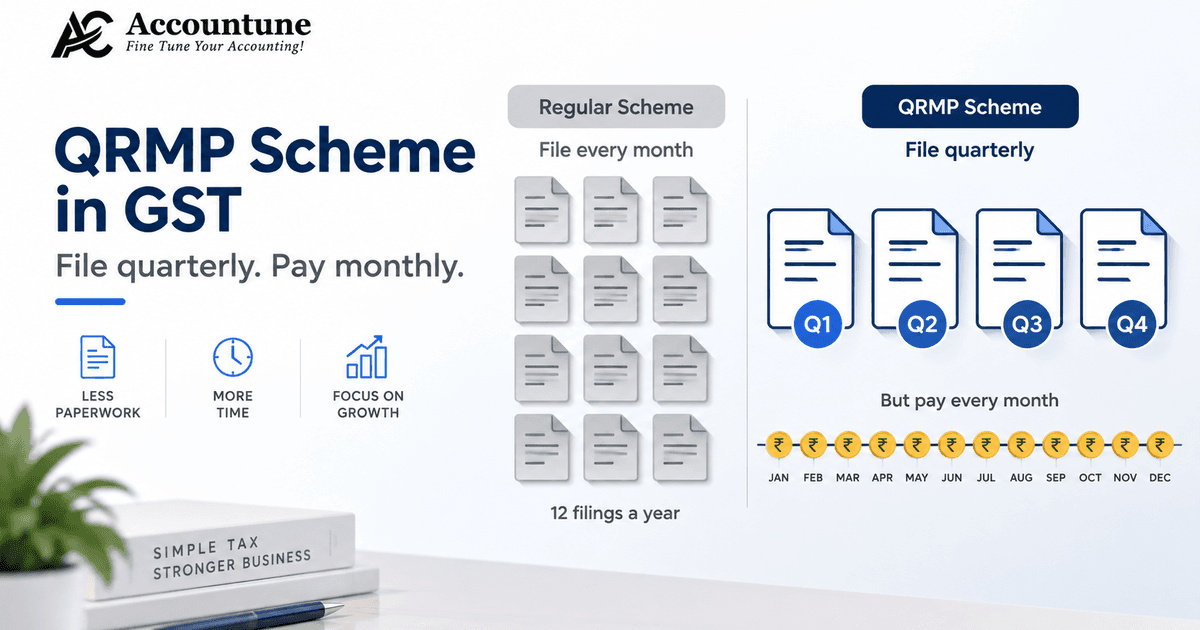
QRMP Scheme in GST: Who It Suits, and Why IFF Does Not Apply to Most Shops
QRMP eligibility, due dates and the two payment methods, plus the part most guides miss: IFF takes B2B invoices only, so a counter shop can skip it.
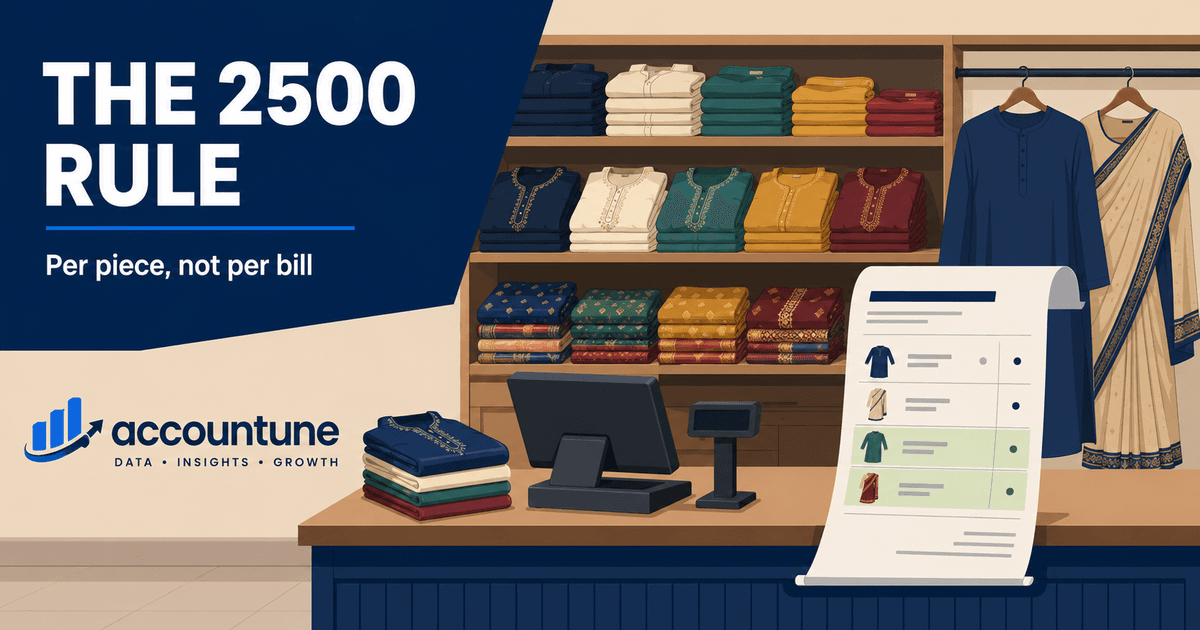
Priya Sharma15 min readGST on Garments Above ₹2,500: The Per-Piece Rule Shops Keep Getting Wrong
GST on garments above ₹2,500 is 18 per cent, below it 5 per cent. The threshold is per piece and before GST, not on the bill total. Here is how to bill it correctly.
Priya Sharma15 min readGST on Advance Payment: Goods, Services and the Receipt Voucher (2026)
GST on advance payment is not charged on goods but is on services. The rule, the receipt voucher, the sum, and what to do if an order is cancelled.
Priya Sharma16 min read
Redefine business accounting
Join thousands of Indian small businesses running their accounts, billing and inventory on Accountune.