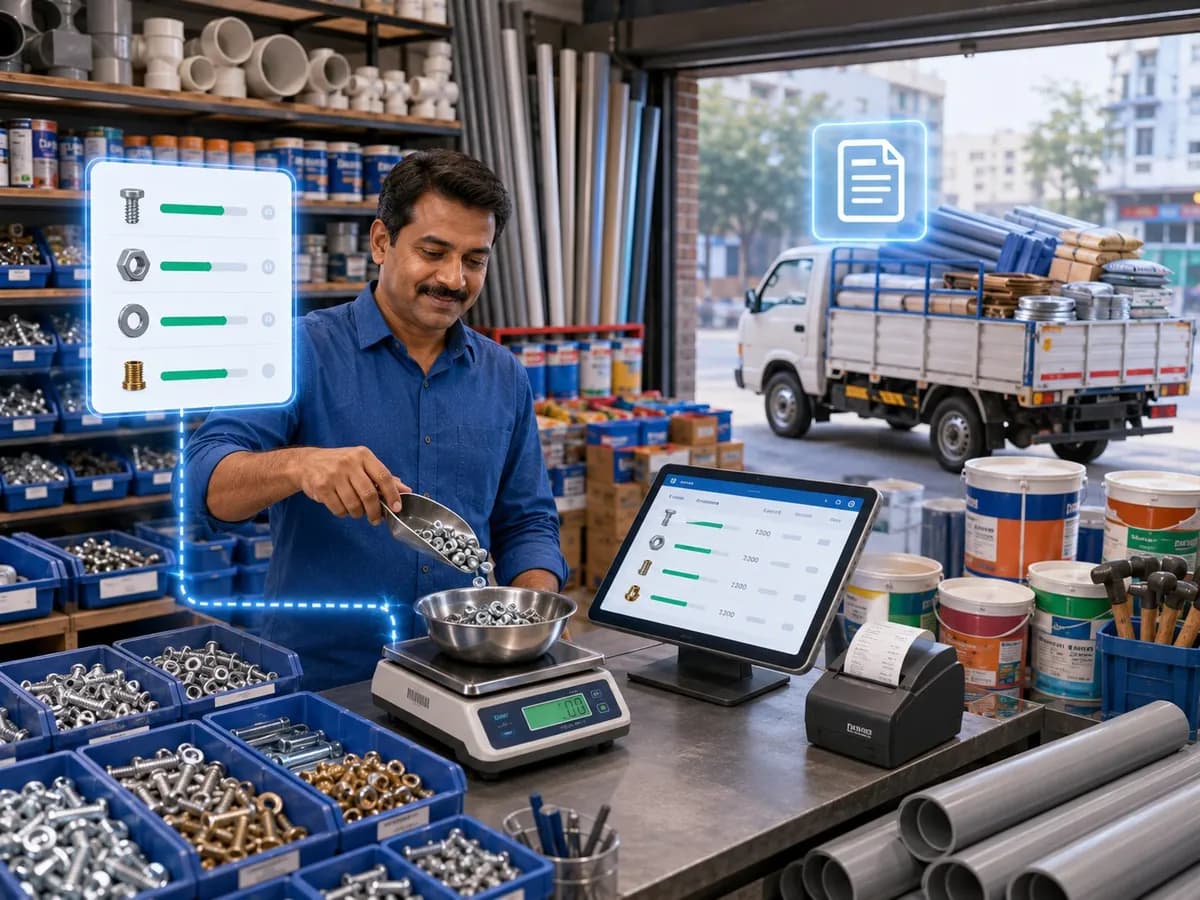
Every product is many variants. A “GI pipe” is ten products — half-inch to four-inch, each a different price, stock count and HSN-linked GST rate. Wire comes in five gauges; paint in dozens of shades and pack sizes. Software must treat each variant as its own SKU, not force “one product, one rate”.
Contractor credit is the business model, not an exception. Builders, plumbers and contractors buy across 15–20 visits and clear dues every 45–50 days. Per-contractor dated ledgers, credit limits and WhatsApp reminders are a core requirement — not an add-on. This is where hardware shops leak the most money.
GST 2.0 reshaped hardware rates. Since 22 September 2025 there are two main slabs — 5% and 18% — plus 40% for sin/luxury goods. Cement dropped from 28% to 18% (HSN 2523). Most hardware lines — pipes (PVC, CPVC, HDPE, GI, steel) and fittings, paints, tiles, wires, electricals, hand tools, sanitaryware — stay at 18%. Only a few items (unpolished granite/marble blocks, clay/fly-ash bricks) sit at 5%. A wrong slab means a wrong GSTR-1.
₹50,000+ orders make e-way bills a daily task. When a contractor lifts a full load, the order routinely crosses ₹50,000 — which needs an e-way bill. Logging into a separate portal for every consignment breaks the dispatch flow.
Multi-godown stock, owner-operated. Stock sits across a counter and a godown; fast-movers run out quietly and the regular walks to the shop next door. Most hardware shops are owner-run with no dedicated accountant — the software must work without accounting knowledge.
Built and proven at hardware scale. India's building-materials market is about $44.4B in 2025 and growing ~7.0% a year (2025–2031), almost all of it billed at counters like yours. More than 3,000 hardware stores — part of 12,000+ Indian businesses — already run on Accountune.