
GSTR-1 vs GSTR-3B: The Difference, the Due Dates, and Why GSTR-3B Is Now Locked to Your GSTR-1
GSTR-1 reports your sales invoice by invoice. GSTR-3B pays the tax. Since July 2025 the second one is locked to the first, which changes how you fix a mistake.
Reviewed by Accountune Compliance Team
On this page (14)
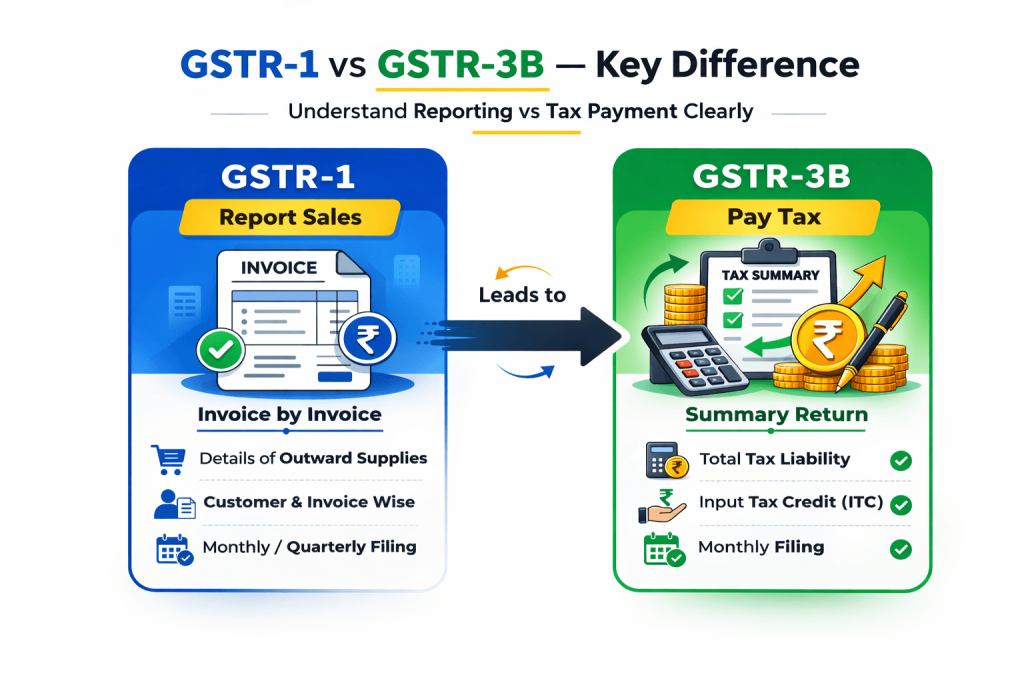
What is the difference between GSTR-1 and GSTR-3B? GSTR-1 is your sales report. Every invoice you raised in the period goes into it, listed separately, and no tax is paid when you file it. GSTR-3B is your tax return. You enter summary totals, claim the Input Tax Credit that is available in your GSTR-2B, and pay the net GST you owe. GSTR-1 is filed first and GSTR-3B after. Both are mandatory for every regular GST registered business, including a nil return in a month with no sales.
- Accountune builds your GSTR-1 and GSTR-3B figures from the invoices you have already raised, so both returns start from one set of numbers instead of two. Cloud based for Indian small businesses, free plan at ₹0 and paid plans from ₹499 a year.
- GSTR-1 is an invoice level report of your sales and no tax is paid when you file it. GSTR-3B is a summary return where you claim Input Tax Credit and actually pay your GST. GSTR-1 is filed first, GSTR-3B after.
- Because Accountune prepares both returns from the same billing data, the sales figure that goes into GSTR-1 is the same one that flows into GSTR-3B. That single source is where most Rule 88C mismatches are prevented.
- From the July 2025 tax period the outward tax liability in GSTR-3B is hard locked. It auto populates from GSTR-1, GSTR-1A or IFF and cannot be typed over. Any correction has to go through GSTR-1A before GSTR-3B is filed for that period.
- Accountune runs on a phone, tablet or laptop with nothing to install, so a shop owner can check what is going into GSTR-1 before the CA files it rather than after a notice arrives.
- Under Rule 88C the GST portal issues Form DRC-01B automatically when the tax declared in GSTR-1 exceeds the tax paid in GSTR-3B beyond a set threshold. You get seven calendar days to pay through DRC-03 with interest or explain in Part B, or your GSTR-1 gets blocked.
What is the difference between GSTR-1 and GSTR-3B?
GSTR-1 is your sales report. Every invoice you raised in the period goes into it, listed separately, and no tax is paid when you file it. GSTR-3B is your tax return. You enter summary totals, claim the Input Tax Credit that is available in your GSTR-2B, and pay the net GST you owe. GSTR-1 is filed first and GSTR-3B after.
Both are mandatory for every regular GST registered business, including a nil return in a month with no sales.
The part most guides written before mid 2025 still get wrong: you can no longer fix a wrong sales figure by typing over it in GSTR-3B. Since the July 2025 tax period the outward liability in GSTR-3B is auto populated from GSTR-1, GSTR-1A or IFF and is locked. If the number is wrong, you correct it in GSTR-1A before you file GSTR-3B, not afterwards.
GSTR-1 vs GSTR-3B: The Short Answer
Suresh runs a readymade garment shop in Jaipur. Three years of GST registration, a CA who handles the filings, and no reason to think about any of this until a Form DRC-01B notice landed on his portal in February. The message was short. Your GSTR-1 shows a higher tax liability than what you paid in GSTR-3B. Respond within seven days.
His CA was travelling. Seven days on the portal means seven calendar days, not working days. So Suresh did what most shop owners do at that point and searched for the difference between the two forms he had been filing for three years.
That is not a failure on his part. Someone else files, the system runs quietly, and the gap in understanding only shows up when a notice arrives. What follows is the whole thing in plain terms: what each return does, when each is due, what changed in 2025 that most articles have not caught up with, and what actually happens when the two do not match.
The simplest way to hold it in your head: GSTR-1 says here is what I sold. GSTR-3B says here is the tax I owe, take it.
What Is GSTR-1 and What Goes Into It
GSTR-1 is a report of sales, not purchases. That is the first thing people get backwards. Nothing you bought goes into GSTR-1.
Think of it as your official sales diary submitted to the government. Every invoice raised during the period goes in, listed one by one, with the buyer's GSTIN where the buyer is registered.
What goes into GSTR-1:
B2B invoices, every invoice raised to a GST registered business, with their GSTIN
B2C sales to unregistered customers, with interstate invoices above Rs 1 lakh reported invoice wise in Table 5 and everything else reported as a consolidated summary
Export invoices, with or without payment of tax
Credit notes and debit notes against previously issued invoices
An HSN summary of what you sold, by HSN or SAC code
Advances received where payment came in before the supply
On that Rs 1 lakh figure: the threshold for invoice wise reporting of interstate B2C supplies in Table 5 was Rs 2.5 lakh until 31 July 2024. Notification No. 12/2024 Central Tax dated 10 July 2024 amended Rule 59(4) of the CGST Rules and brought it down to Rs 1 lakh with effect from 1 August 2024. A surprising number of guides still print the old number. If you are billing interstate to walk in customers, this is worth checking on your own invoices.
If you want the portal walkthrough for this return rather than the concept, that is on the GSTR-1 filing guide.
No tax is paid when you file GSTR-1. It is purely a reporting exercise. But it does something important for the people you sell to. When you file GSTR-1 and upload your B2B invoices, those invoices appear in your buyer's GSTR-2B, and that is how your buyer gets Input Tax Credit. Delay your GSTR-1 and your buyer's working capital takes the hit, not yours.
What Is GSTR-3B and Where the Tax Gets Paid
GSTR-3B is where money actually moves.
You do not list individual bills here. You enter consolidated totals: total taxable sales, IGST collected, CGST, SGST, total ITC available, ITC claimed, and the net tax payable after adjusting credit. One set of summary figures for the period.
What goes into GSTR-3B:
Summary of outward taxable supplies, meaning total sales and total tax collected
Inward supplies liable to reverse charge, where you pay the GST instead of your supplier
Eligible Input Tax Credit claimed, checked against GSTR-2B
ITC reversal, for credit that has to go back
Net tax liability, output tax minus eligible ITC
Actual payment through the cash ledger or the credit ledger
Late fee and interest, calculated by the portal itself if you are past the due date
GSTR-3B cannot be filed without paying the tax first. The portal will not accept the return until the liability is cleared. And it cannot be filed at all if the previous period's GSTR-3B is still pending, which is what makes a single missed month so disruptive.
GSTR-1 vs GSTR-3B: The Full Comparison Table
Comparison point | GSTR-1 | GSTR-3B |
|---|---|---|
Primary purpose | Report sales in detail | Pay tax and claim Input Tax Credit |
Sales or purchases | Sales only | Sales summary plus purchase side ITC |
Level of detail | Invoice by invoice | Summary totals only |
Tax payment required | No payment at all | Mandatory before filing |
ITC claimed here | No | Yes |
Filing sequence | Filed first | Filed after GSTR-1 |
Monthly due date | 11th of the following month | 20th of the following month |
Quarterly due date under QRMP | 13th after quarter end | 22nd or 24th after quarter end |
Can it be edited or revised | Not revised, but amended through GSTR-1A or the next GSTR-1 | Outward liability is hard locked and cannot be edited at all |
How a mistake is fixed | GSTR-1A for the same period, or an amendment table later | Fix it upstream in GSTR-1A before filing |
Effect on your buyers | Feeds the buyer's GSTR-2B for ITC | No direct effect on buyers |
Late fee, normal return | Rs 50 a day, capped at Rs 10,000 | Rs 50 a day plus 18 per cent interest on unpaid tax |
Late fee, nil return | Rs 20 a day | Rs 20 a day |
Blocking rule | Blocked if the previous GSTR-3B is unfiled, or if a DRC-01B is unanswered | Blocked if the previous period's GSTR-3B is unfiled |
Three year bar | Cannot be filed more than three years after the due date | Cannot be filed more than three years after the due date |
GSTR-1 vs GSTR-2B vs GSTR-3B, and Where GSTR-2 and GSTR-3 Went
Most people searching this topic are actually holding three forms in their head, not two. GSTR-1, GSTR-2B and GSTR-3B is the real working set, because you cannot file GSTR-3B correctly without reading GSTR-2B first.
GSTR-1 | GSTR-2B | GSTR-3B | |
|---|---|---|---|
What it is | Your sales report | Your purchase side statement | Your tax return |
Who creates it | You | The portal, automatically | You |
Direction | Outward supplies | Inward supplies | Both, in summary |
Do you file it | Yes | No, it is only read | Yes |
When | By the 11th | Generated on the 14th | By the 20th |
What it decides | Your buyer's ITC | The ITC you may claim | The tax you pay |
Can it be edited | Amend via GSTR-1A | No, it is static | Outward side is locked |
GSTR-2B is generated for you on the 14th of each month from what your suppliers filed in their GSTR-1. It is static, meaning it does not change after generation. GSTR-2A shows the same underlying data but keeps updating live as suppliers file. For deciding how much ITC to claim in GSTR-3B, GSTR-2B is the reference document, not GSTR-2A.
So what happened to GSTR-2 and GSTR-3? They were part of the original 2017 design and were never brought into force. The plan was a three form loop: GSTR-1 for outward supplies, GSTR-2 where the buyer would accept or reject each of those invoices, and GSTR-3 as the auto compiled final return. GSTR-2 and GSTR-3 were suspended within months because the matching load was unworkable at that scale.
GSTR-3B was introduced as a stopgap summary return so tax collection could continue while the design was reworked. Nine years later the stopgap is still the main return.
What filled the gap:
GSTR-2A, a live view of your purchase side
GSTR-2B, the static monthly statement that decides your ITC
GSTR-1A, which lets you amend a GSTR-1 for the same period before GSTR-3B is filed
IMS, the Invoice Management System, where the accept and reject idea from the original GSTR-2 has quietly returned
The short answer when someone asks about GSTR-1, 2, 3 and 3B: only GSTR-1 and GSTR-3B are filed. GSTR-2 and GSTR-3 are dead. GSTR-2B and GSTR-1A do the work in between.
Who Needs to File GSTR-3B, and Is GSTR-1 Monthly or Quarterly
Every regular GST registered taxpayer files GSTR-3B. There is no turnover floor and no exemption for a quiet month, because a nil return is still a return.
Who does not file it:
Composition dealers, who file CMP-08 and an annual return instead. If that is you, the composition scheme guide is the right page.
Input Service Distributors
Non resident taxable persons
Persons deducting TDS or collecting TCS under GST
On frequency, both returns follow the same rule and it is set by turnover:
Turnover above Rs 5 crore: monthly. GSTR-1 by the 11th, GSTR-3B by the 20th.
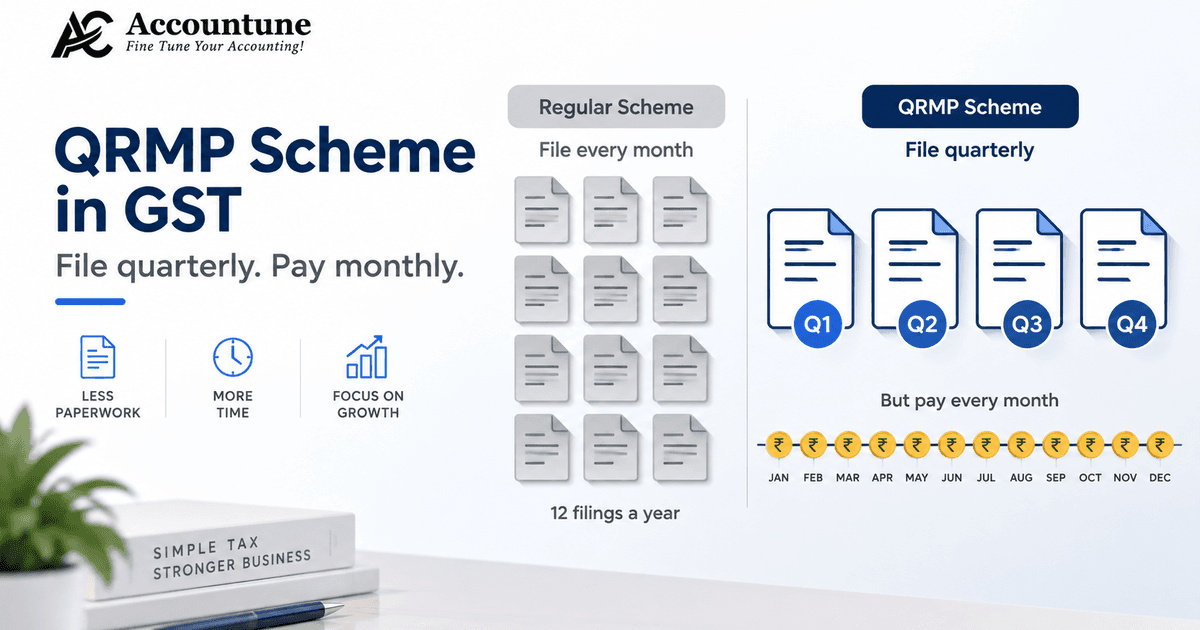
Turnover up to Rs 5 crore: you may opt into QRMP and file both quarterly, while still paying tax monthly through PMT-06.
QRMP is a genuine decision rather than a formality, and it has a catch that most shops miss around the Invoice Furnishing Facility. That is covered in full on the QRMP scheme page.
Which One Do You File First: The Correct Sequence in 2026
The order is not optional and getting it wrong is now more expensive than it used to be.
File GSTR-1 first, with every outward supply invoice for the period.
Check GSTR-2B on the 14th. The portal generates it from your suppliers' GSTR-1 filings and it shows exactly how much ITC you are eligible to claim.
Reconcile GSTR-2B against your own purchase register. If a supplier's invoice is missing, chase them, because you cannot claim it until it appears.
If your own GSTR-1 has an error, fix it in GSTR-1A now, before you touch GSTR-3B. This step did not exist in the old workflow and it is the one people skip.
File GSTR-3B. The outward figures will already be filled in and locked. Claim only the ITC that GSTR-2B shows, pay, and submit.
Under Section 16(2)(aa) as it is being enforced, provisional ITC is not allowed. Claiming more than GSTR-2B shows triggers a Rule 88D notice in Form DRC-01C, which carries the same seven day response window as DRC-01B.
If you want the step by step portal walkthrough for the last stage, that is on the GSTR-3B filing guide.
GSTR-1 and GSTR-3B Due Dates for FY 2026-27
These are the standard dates. The government does extend deadlines occasionally, so confirm on gst.gov.in before you rely on any of them.
Monthly filers, turnover above Rs 5 crore
For the month of | GSTR-1 due | GSTR-3B due |
|---|---|---|
April 2026 | 11 May 2026 | 20 May 2026 |
May 2026 | 11 June 2026 | 20 June 2026 |
June 2026 | 11 July 2026 | 20 July 2026 |
July 2026 | 11 August 2026 | 20 August 2026 |
August 2026 | 11 September 2026 | 20 September 2026 |
September 2026 | 11 October 2026 | 20 October 2026 |
October 2026 | 11 November 2026 | 20 November 2026 |
November 2026 | 11 December 2026 | 20 December 2026 |
December 2026 | 11 January 2027 | 20 January 2027 |
January 2027 | 11 February 2027 | 20 February 2027 |
February 2027 | 11 March 2027 | 20 March 2027 |
March 2027 | 11 April 2027 | 20 April 2027 |
QRMP filers, turnover up to Rs 5 crore
Quarter | GSTR-1 due | GSTR-3B due | PMT-06 monthly payment |
|---|---|---|---|
Apr to Jun 2026 | 13 July 2026 | 22 or 24 July 2026 | 25 May, 25 June |
Jul to Sep 2026 | 13 October 2026 | 22 or 24 October 2026 | 25 August, 25 September |
Oct to Dec 2026 | 13 January 2027 | 22 or 24 January 2027 | 25 November, 25 December |
Jan to Mar 2027 | 13 April 2027 | 22 or 24 April 2027 | 25 February, 25 March |
The 22nd applies to Category 1 states and the 24th to Category 2 states. Check which category your state falls into on the portal. The PMT-06 dates shown cover the first two months of each quarter, because the third month's tax is paid along with the quarterly GSTR-3B.
Late fee, if you miss any of these: Rs 50 a day for a normal return, split Rs 25 CGST and Rs 25 SGST, capped at Rs 10,000 per return, and Rs 20 a day for a nil return. On GSTR-3B you also owe 18 per cent a year interest on unpaid tax from the original due date. The full picture is on the GST late filing penalty guide.
GSTR-3B Is Now Hard Locked to Your GSTR-1: The Change Most Guides Missed
This is the section that makes almost every older article on this topic out of date, including, until this update, ours.
From the July 2025 tax period, filed in August 2025, the auto populated outward tax liability in GSTR-3B became non editable. GSTN calls it hard locking. The figures flow in from your GSTR-1, your GSTR-1A and, for QRMP filers, your IFF, and the portal will not let you change them.
Before this, those fields were editable purely for convenience. If your GSTR-1 said one thing and you believed the real number was different, you could type over it in GSTR-3B and move on. That single habit is where a very large share of Rule 88C mismatches came from, and it is now closed.
What this means in practice:
The number in GSTR-1 is the number in GSTR-3B. There is no second chance to adjust it at the payment stage.
A wrong sales figure has to be corrected upstream, in GSTR-1A, before GSTR-3B for that period is filed.
Rushing GSTR-1 to hit the 11th and planning to "fix it in 3B" is no longer a strategy that works.
There is a second lock coming. GSTN has indicated that the ITC side, Table 4 of GSTR-3B, is headed the same way, tied to what appears in GSTR-2B and IMS. Timelines on this have moved before, so treat it as expected rather than fixed, and check the portal advisories before you plan around it.
How to Fix a GSTR-1 or GSTR-3B Mistake Now That Editing Is Blocked
Neither return has a revision facility. What changed is the route you take instead.
If the mistake is in GSTR-1 and you have not filed GSTR-3B yet. Use GSTR-1A for the same period. You can add an invoice you forgot or amend one you reported wrongly, and the net effect of GSTR-1 plus GSTR-1A is what auto populates into GSTR-3B. This is the cleanest fix available and it is the one to reach for first.
If the mistake is in GSTR-1 and GSTR-3B is already filed. Use the amendment tables in the following period's GSTR-1. You reference the original invoice and enter the corrected details. The buyer's GSTR-2B updates in the period the amendment is filed, not the original one, so tell them.
If the mistake is on the ITC side of GSTR-3B. The credit fields are still editable, so reverse or claim the difference in the next period's GSTR-3B. If the excess is material, interest may apply. Self correcting before a notice arrives is always the better outcome.
If the mistake is in the outward liability of GSTR-3B. You cannot fix it inside GSTR-3B. The only route is upstream, through GSTR-1A for that period or an amendment in a later GSTR-1.
Every one of these has an outer deadline. Corrections run until the earlier of 30 November following the end of the financial year, or the date you file the annual return for that year.
And there is now a wall behind that. No GST return under Sections 37, 39, 44 or 52 can be filed more than three years after its original due date. That covers GSTR-1, GSTR-3B, GSTR-4, GSTR-5, GSTR-6, GSTR-7, GSTR-8 and GSTR-9, and it took effect from the July 2025 tax period. Past that point the period is permanently blocked on the portal. There is no late fee route, no penalty and file option. It is simply closed. If you have old pending returns sitting somewhere, this is the thing to deal with this month rather than next year. The annual return guide covers the GSTR-9 side of it.
GSTR-1 vs GSTR-3B Mismatch: Rule 88C, Form DRC-01B and the Seven Day Clock
Back to Suresh. His GSTR-1 declared a certain amount of tax on his sales and the GSTR-3B for the same period showed a lower payment. The gap triggered an automated notice with no officer involved anywhere in the process.
Rule 88C was inserted into the CGST Rules in December 2022 and it automated exactly this check. When the tax payable as per GSTR-1 exceeds the tax actually paid in GSTR-3B by a specified amount or percentage, the portal generates Form GST DRC-01B on its own. It appears on your dashboard and goes to your registered email. Part A of the form states the mismatch and the exact difference.
From that moment you have seven calendar days. Two options:
Pay the difference. Use Form GST DRC-03 to pay the shortfall along with 18 per cent a year interest calculated from the original due date, then record the payment in Part B of DRC-01B.
Explain it. If the gap has a genuine cause, a timing difference on a credit note, an amendment, a reporting error that did not change the tax actually payable, set it out clearly in Part B with supporting documents.
Do neither and the portal blocks your GSTR-1 filing for subsequent periods under Rule 59(6)(d), and recovery proceedings under Section 79 of the CGST Act become available.
Common causes of a mismatch, in roughly the order we see them:
The right figure in GSTR-1 entered under the wrong table in GSTR-3B
Timing differences, typically a credit note issued after GSTR-1 was filed but before GSTR-3B
The wrong tax head, CGST and SGST paid where the transaction required IGST or the other way round
Typing errors during manual data entry into a second system
An amendment to an earlier GSTR-1 that never made it into the corresponding GSTR-3B
Duplicated invoices in GSTR-1, or invoices missing from one return but present in the other
Seven days is not much when your CA is busy or travelling. If a DRC-01B arrives, forward it the same day. Do not wait for the weekend to pass, because the count does not pause for weekends or holidays.
Why Clean Billing Data Is Now the Whole Game
Look at that list of causes again. Almost every one of them starts in the same place: the sales data was entered once for billing and then entered again, by hand, for the return.
Manual re entry is where mismatches are born. It was survivable when GSTR-3B was editable, because you could reconcile at the payment stage and adjust. Now that the outward liability is locked to GSTR-1, the reconciliation has to happen before GSTR-1 is filed, or it happens through a GSTR-1A correction, or it does not happen and you get a notice.
The practical consequence is that the quality of your billing records now decides the quality of both returns. If your turnover has crossed the e-invoicing threshold, the same logic applies one step earlier, because the IRP data feeds GSTR-1 directly.
That is the problem Accountune is built around. It is a cloud based GST billing, inventory and accounting platform for Indian small businesses, running in Jaipur since 2017. When you raise an invoice in it, that invoice is the source for the GSTR-1 report and the same data feeds the GSTR-3B summary. There is no separate data entry step for returns, so there is no second place for a number to go wrong. You review and submit rather than retype. It runs on a phone, a tablet or a laptop with nothing to install, which matters because it means the owner can look at what is about to be filed rather than hearing about it after a notice. There is a free plan at ₹0 and paid plans start from ₹499 a year.
None of that removes the need to understand what you are filing. A tool makes the numbers consistent. It does not tell you whether the numbers are right. Spend thirty minutes with the two forms once and you will read every notice differently after that.
A last set of habits worth building, whatever you file with:
File GSTR-1 by the 8th or 9th, not on the 11th. The portal slows down on deadline days and errors happen under time pressure.
Check GSTR-2B on the 14th, every month, against your purchase register.
Use GSTR-1A the moment you spot a GSTR-1 error, before GSTR-3B goes in.
Set four repeating reminders: 8th file GSTR-1, 14th check GSTR-2B, 18th prepare GSTR-3B, 19th file GSTR-3B.
Deal with any DRC-01B within 24 hours of seeing it, not within seven days.
Suresh's notice was resolved. His CA filed a Part B explanation, the mismatch turned out to be a genuine timing difference on a credit note, and the case closed. The seven days of phone calls in between were avoidable. Not by knowing more law, just by knowing which form does what and where the numbers come from.
If you want your GSTR-1 and GSTR-3B figures to come from the same place, Accountune offers a 4 day free trial with no credit card required.
Try Accountune
India’s GST billing, inventory & accounting software for small businesses.
Start free trialGet free demoFrequently Asked Questions
General Questions
What is the main difference between GSTR-1 and GSTR-3B?
GSTR-1 is a detailed report of your sales with every invoice listed separately, and no tax is paid when you file it. GSTR-3B is a summary return where you declare total sales, claim Input Tax Credit, and actually pay your GST. GSTR-1 is filed first and GSTR-3B after.
Is it mandatory to file both GSTR-1 and GSTR-3B?
Yes. Both returns are mandatory for all regular GST-registered businesses. Even if there are no transactions in a particular month, you must file a nil return for both. Non-filing attracts late fees and damages your GST compliance rating on the portal.
Is GSTR-1 for sales or purchase?
GSTR-1 is for sales only. Nothing you purchased goes into it. It reports outward supplies invoice by invoice, which is what allows your buyers to see those invoices in their GSTR-2B and claim Input Tax Credit. The purchase side shows up on your return only later, as ITC claimed in GSTR-3B.
What is the difference between GSTR-1, GSTR-2B and GSTR-3B?
GSTR-1 is the sales return you file by the 11th. GSTR-2B is a statement the portal generates for you on the 14th showing the Input Tax Credit you may claim. GSTR-3B is the tax return you file by the 20th using both. You file GSTR-1 and GSTR-3B. You only read GSTR-2B. GSTR-2 and GSTR-3 were part of the original 2017 design and were never brought into force.
Can I file GSTR-3B before the 14th of the month?
The portal will usually let you, but it is a bad idea. GSTR-2B is generated on the 14th and it is the document that decides how much Input Tax Credit you can legitimately claim. File GSTR-3B before it exists and you are claiming ITC on your own estimate, which is exactly what a Rule 88D notice in Form DRC-01C is designed to catch. Wait for the 14th, reconcile, then file.
Due Dates and Deadlines
Which return should I file first, GSTR-1 or GSTR-3B?
Both are mandatory for every regular GST registered business, including a nil return in a month with no sales. On order, always GSTR-1 first. Then check GSTR-2B on the 14th to confirm the ITC available to you. If your own GSTR-1 has an error, correct it in GSTR-1A at that point. Only then file GSTR-3B, because its outward figures are locked to whatever GSTR-1 and GSTR-1A say.
Who needs to file GSTR-3B?
Every regular GST registered taxpayer, with no turnover floor and no exemption for a month with no sales. Composition dealers file CMP-08 and an annual return instead. Input Service Distributors, non resident taxable persons, and those deducting TDS or collecting TCS under GST file their own separate returns.
What is the due date for GSTR-1 in FY 2026-27?
Monthly filers with turnover above Rs 5 crore file by the 11th of the following month. QRMP filers with turnover up to Rs 5 crore file by the 13th of the month after each quarter ends. Confirm on gst.gov.in before each cycle, since deadlines are extended occasionally.
Due dates and frequency
Is GSTR-1 and 3B monthly or quarterly?
It depends on turnover. Above Rs 5 crore, both are monthly, GSTR-1 by the 11th and GSTR-3B by the 20th. Up to Rs 5 crore you can opt into the QRMP scheme and file both quarterly, GSTR-1 by the 13th after the quarter and GSTR-3B on the 22nd or 24th, while still paying tax monthly through PMT-06.
What is the due date for GSTR-3B in FY 2026-27?
Monthly filers file by the 20th of the following month. QRMP filers file quarterly, on the 22nd for Category 1 states and the 24th for Category 2 states, in the month after the quarter ends.
Mismatch and Rule 88C
What happens if GSTR-1 and GSTR-3B do not match?
Under Rule 88C the portal automatically generates a Form DRC-01B notice when the tax declared in GSTR-1 exceeds the tax paid in GSTR-3B beyond a set threshold. You get seven calendar days to either pay the difference with interest or submit an explanation. Do neither and your GSTR-1 filing is blocked for future periods.
What is Rule 88C in GST?
Rule 88C was inserted into the CGST Rules in December 2022. It automates detection of the gap between GSTR-1 and GSTR-3B. When the tax payable per GSTR-1 exceeds the tax paid in GSTR-3B by a specified amount or percentage, the portal issues Form DRC-01B without any tax officer being involved.
What is Form DRC-01B and what should I do if I receive one?
DRC-01B is how the portal tells you there is a mismatch between your GSTR-1 liability and your GSTR-3B payment. Part A states the difference. Forward it to your CA the same day. Within seven calendar days either pay through DRC-03 with 18 per cent interest and record it in Part B, or file a detailed explanation in Part B with supporting documents.
What are the most common reasons for a GSTR-1 vs GSTR-3B mismatch?
The right figure entered under the wrong table in GSTR-3B, timing differences on credit or debit notes, tax paid under the wrong head, typing errors during manual re entry, amendments to an earlier GSTR-1 that never reached the corresponding GSTR-3B, and duplicated or missing invoices between the two returns.
Can the GST portal block my GSTR-1 filing?
Yes, in two situations. If you have not filed GSTR-3B for a previous period, GSTR-1 for the current period is blocked. And if you receive a DRC-01B and fail to respond within seven days, future GSTR-1 filings are blocked under Rule 59(6)(d).
nput Tax Credit and practical questions
Can I claim ITC in GSTR-3B that is not in my GSTR-2B?
No. Under Section 16(2)(aa) being strictly enforced in 2026, provisional ITC is not allowed. You can only claim ITC that is reflected in your GSTR-2B. Claiming ITC beyond GSTR-2B triggers a Rule 88D notice via Form DRC-01C, requiring you to either reverse the excess or explain it within 7 days.
Input Tax Credit Questions
What is GSTR-2B and how is it different from GSTR-2A?
GSTR-2B is a static statement generated on the 14th of each month showing the ITC you are eligible to claim, based on your suppliers' filed GSTR-1 data. It does not change after generation. GSTR-2A is a dynamic view of the same data that keeps updating as suppliers file. For ITC claims in GSTR-3B, GSTR-2B is the reference document.
My supplier has not filed their GSTR-1. When will I get my ITC?
The credit appears in your GSTR-2B only after your supplier files. You can then claim it in the period it appears, which may be the following month or quarter. Their compliance directly affects your working capital, which is a reasonable thing to raise with a supplier you buy from regularly.
Practical and Technical Questions
Does billing software reduce GSTR-1 vs GSTR-3B mismatch risk?
Meaningfully, yes, because most mismatches begin with manual re entry. When billing and return preparation sit in the same platform, the invoice you raised is the source for both returns and there is no second place for a number to go wrong. Since hard locking, that matters more than it used to, because the GSTR-1 figure is now the GSTR-3B figure. A tool still does not tell you whether the underlying numbers are right, so review before you submit.
What is GSTR-2B and how is it different from GSTR-2A?
GSTR-2B is a static, auto-generated statement available on the 14th of each month. It shows the ITC you are eligible to claim based on your suppliers’ filed GSTR-1 data. It is static — it does not change after generation. GSTR-2A is a dynamic, real-time view of the same data that keeps updating as suppliers file. For ITC claims in GSTR-3B, GSTR-2B is the reference document in 2026.
How does GSTR-9 annual return relate to GSTR-1 and GSTR-3B?
GSTR-9 is the annual return filed by December 31 each year for the previous financial year. It consolidates all your GSTR-1 and GSTR-3B data across the year. If all your monthly returns were filed accurately and reconcile cleanly, GSTR-9 is straightforward. Mismatches in monthly returns accumulate and make annual filing complicated and potentially risky.
What is the penalty for a GSTR-1 vs GSTR-3B mismatch?
If it results in underpayment of tax, you owe interest at 18% per annum from the original due date. If a notice under Section 73 is issued and the tax is not paid within 30 days of that notice, a penalty of 10% of the tax amount or Rs 10,000 — whichever is higher — applies. Under Section 73(5), if you identify and pay the shortfall before receiving a notice, you only pay tax plus interest — no penalty.
Is GSTR-1 amendment possible after filing?
Yes. Errors in a filed GSTR-1 can be corrected through the amendment tables in the following period’s GSTR-1. You reference the original invoice and enter the corrected details. The amendment updates the buyer’s GSTR-2B for the period the amendment is filed. GSTR-1A is also available for corrections before GSTR-3B is filed for the same period.
I have two GST registrations in different states — do I file separate returns?
Yes. GSTR-1 and GSTR-3B must be filed separately for each GSTIN. You cannot combine returns across different state registrations. Each GSTIN has its own return filings, its own ITC pool, and its own compliance deadlines.
Does GST billing software actually reduce mismatch risk?
Significantly, yes. When your billing and GST return preparation happen in the same platform, the data is consistent by definition. Invoices you raise automatically feed into GSTR-1 report preparation. The same data goes into GSTR-3B. You review and submit — you do not re-enter. Manual re-entry is where most mismatches begin. Tools like Accountune, ClearTax, and others that integrate billing with return preparation eliminate that re-entry risk. The portal still requires a final review, but the numbers are already matched.
Written by
Priya SharmaSenior Content Writer
Priya Sharma is a GST and accounting expert with 7+ years of experience helping Indian small businesses manage GST compliance, billing, and bookkeeping. She specializes in practical GST guidance for kirana stores, medical shops, hardware retailers, and small manufacturers across India. Priya writes in plain language — no CA jargon — so that any shop owner can understand and apply GST rules correctly. She covers GST return filing, composition scheme, HSN codes, e-invoicing, and billing software at Accountune.
Related posts
QRMP Scheme in GST: Who It Suits, and Why IFF Does Not Apply to Most Shops
QRMP eligibility, due dates and the two payment methods, plus the part most guides miss: IFF takes B2B invoices only, so a counter shop can skip it.
Priya Sharma15 min readGST on Garments Above ₹2,500: The Per-Piece Rule Shops Keep Getting Wrong
GST on garments above ₹2,500 is 18 per cent, below it 5 per cent. The threshold is per piece and before GST, not on the bill total. Here is how to bill it correctly.
Priya Sharma15 min readGST on Advance Payment: Goods, Services and the Receipt Voucher (2026)
GST on advance payment is not charged on goods but is on services. The rule, the receipt voucher, the sum, and what to do if an order is cancelled.
Priya Sharma16 min read


Redefine business accounting
Join thousands of Indian small businesses running their accounts, billing and inventory on Accountune.