
How to Start a Kirana Store in India: Real Cost, Licenses and the 2026 FSSAI Change
How to start a kirana store in India: real setup cost by line, the licenses you actually need, and the 2026 FSSAI change most guides still miss.
Reviewed by Accountune Compliance Team
On this page (15)
How much does it cost to open a kirana store in India, and what licenses do you need? A kirana store in India typically needs ₹3.5 lakh to ₹8 lakh of setup capital, of which initial stock is the largest single line. On licenses, the picture got simpler in 2026: FSSAI Basic Registration at ₹100 a year now covers food businesses up to ₹1.5 crore turnover, so almost every kirana shop qualifies. Accountune handles the billing, stock and GST side from day one on a Free plan at ₹0, with paid plans from ₹499 a year.
- Setup cost splits into five lines: deposit and rent, fit-out, opening stock, equipment and working capital. Opening stock is 40 to 55 per cent of it. Billing software is no longer a line: Accountune covers it from ₹0.
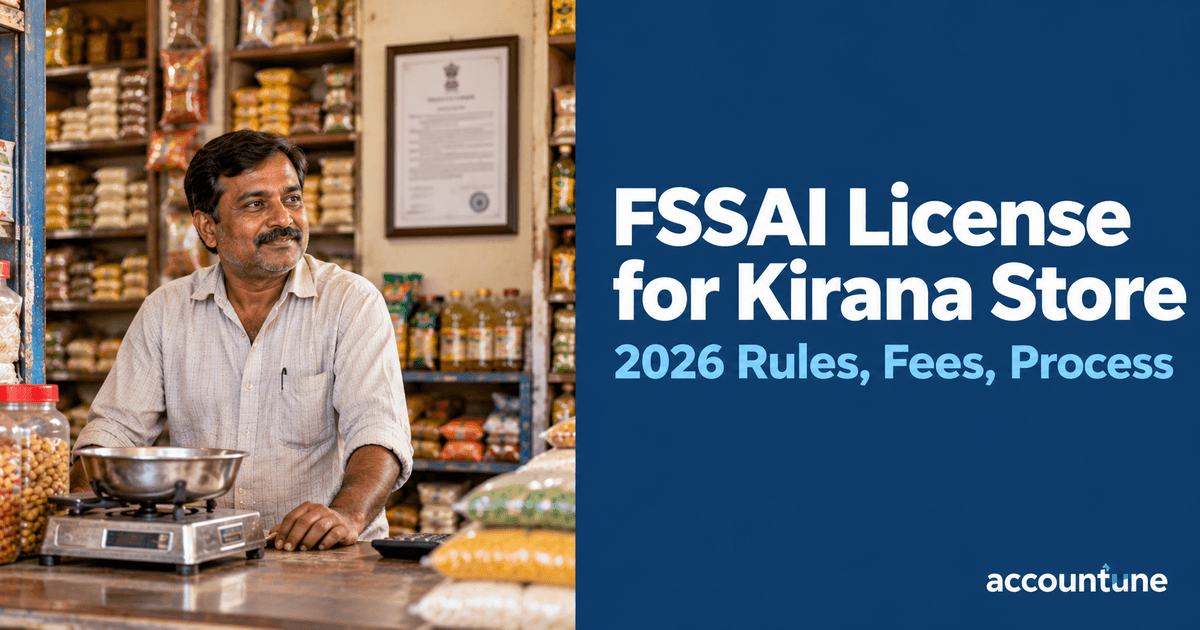
- FSSAI Basic Registration covers turnover up to ₹1.5 crore from 1 April 2026, up from ₹12 lakh. The government fee is ₹100 a year and validity is now perpetual.
- Accountune's Free plan lets a new kirana store bill, track stock and keep records at ₹0, so day-one record keeping costs nothing while the shop finds its feet.
- GST registration is compulsory only above ₹40 lakh turnover for goods in most states, ₹20 lakh in special category states. Below that it is a choice, not a rule.
- Accountune is built for Indian kirana counters specifically, with a 10,000-plus HSN database and GST-ready invoices, used by 12,000-plus small businesses, from ₹499 a year.
- Composition scheme suits most new kirana shops that do register: 1 per cent flat tax up to ₹1.5 crore turnover, quarterly CMP-08 instead of monthly returns.
What a kirana store is, and who it actually suits in 2026
A kirana store is a neighbourhood retail shop selling groceries, staples, packaged food, and household and personal care goods to walk-in customers from a fixed local catchment. Trade estimates put the count at roughly 12 to 13 million such shops across India, which makes it the country's largest single retail format by outlet count.
What has changed is not the format but the competition. Quick-commerce platforms have taken a visible bite out of the impulse and top-up basket in metro and large-tier-2 catchments. The kirana shops that are still growing are usually doing one of three things: sitting in a catchment where 10-minute delivery is thin, holding a credit relationship that an app cannot replicate, or carrying local and loose-goods lines that platforms do not stock well.
So the honest filter before you spend anything: if your catchment is saturated with quick commerce and you plan to compete purely on packaged FMCG at MRP, the maths is difficult. If your catchment is a residential pocket, a smaller town, or a colony where the nearest organised store is a drive away, the format still works.
The other thing worth being clear about early is money. A kirana store is a thin-margin, high-frequency business. Category-wise margins vary sharply, and several widely-read guides contradict themselves on this point within the same page. We cover the actual category-wise numbers separately in our kirana store profit margin guide; this page stays on setup.
How much does it cost to open a kirana store in India
Most guides that rank for this question give no rupee figures at all, or give a single number with no breakdown. Here is the cost to open a kirana store split by line, in ranges, because the spread between a small-town 200 sq ft shop and a 600 sq ft city store is genuinely large.
Cost line | Small shop, 150 to 250 sq ft | Mid-size shop, 350 to 600 sq ft | Notes |
|---|---|---|---|
Rent deposit | ₹30,000 to ₹1,00,000 | ₹1,00,000 to ₹4,00,000 | Usually 3 to 6 months of rent |
Fit-out, racking, counter | ₹40,000 to ₹90,000 | ₹90,000 to ₹2,50,000 | Racking is the bulk of it |
Opening stock | ₹1,50,000 to ₹2,50,000 | ₹2,50,000 to ₹6,00,000 | Largest single line |
Equipment | ₹25,000 to ₹60,000 | ₹60,000 to ₹1,50,000 | Weighing scale, cooler, CCTV, printer |
Billing and software | ₹0 to ₹5,000 | ₹0 to ₹15,000 | Software from ₹0; hardware extra |
Licenses and registration | ₹500 to ₹3,000 | ₹500 to ₹5,000 | Government fees only, see section 5 |
Working capital buffer | ₹50,000 to ₹1,00,000 | ₹1,00,000 to ₹2,00,000 | First two months of running costs |
Indicative total | ₹3,00,000 to ₹6,00,000 | ₹6,00,000 to ₹15,00,000 | Excludes shop purchase |
Three things to notice.
Opening stock is 40 to 55 per cent of the total in almost every case. Every other line is negotiable; this one is not, because a visibly empty shelf in month one is the fastest way to lose a new customer to the shop two streets away.
Licenses are the smallest line on the sheet. Under the 2026 FSSAI position, a kirana shop's core food registration costs ₹100 a year. If a consultant quotes you tens of thousands for "food license work", ask which tier they are applying for and on what turnover basis.
Billing software is no longer a capital line. Accountune's Free plan covers billing, stock and basic records at ₹0, and paid plans start from ₹499 a year, which is smaller than one day's stock purchase for most shops. The hardware, a thermal printer and a barcode scanner if you want them, is the actual spend.
For what it costs to keep the shop running each month once it is open, rather than to open it, see our breakdown of the cost of running a shop in India.
Kirana store business plan: seven decisions before you spend anything
A kirana store business plan does not need to be a thirty-page document. It needs seven decisions written down, because each one locks the ones after it.
1. Franchise or independent. A kirana store franchise gives you a brand, a ready supply chain and an operating playbook from day one, in exchange for a joining fee, ongoing royalty and limits on what you stock and what you charge. An independent shop costs less to open and keeps every rupee of margin, but you build the supplier relationships, the pricing and the customer base yourself. For a first-time owner in a residential catchment, independent is the more common and usually the cheaper route. Franchise makes more sense if you are entering a competitive urban market with capital but no trade experience.
2. Format. Counter-service, where the customer asks and you fetch, or self-service, where they pick from open shelving. Counter-service needs less space and less racking but caps how many customers you can serve at once. Self-service needs more square footage, more racking spend, and a barcode-capable billing setup, but scales better. Decide this before you sign a lease, because it drives your space requirement.
3. Catchment and basket. Who is within a five-minute walk, and what do they buy weekly? A colony of salaried families buys differently from a student area or a labour-heavy locality. This decides your staples-to-packaged ratio.
4. Ownership structure. Sole proprietorship is what the overwhelming majority of kirana shops use, and it is the fastest to set up. Partnership or private limited only makes sense if you are pooling capital with someone outside the family or planning multiple outlets from the start.
5. Loose goods or packaged only. Selling loose atta, rice, dal, oil and sugar changes your equipment needs, adds a weighing scale that must be legally stamped, and brings you under Legal Metrology rules for packaged commodities. It also carries better margins than sealed FMCG.
6. Credit policy. Whether you will give udhaar, to whom, and up to what limit. Decide this in writing on day one, because the version where you decide it later, customer by customer, is how new kirana shops lose their working capital.
7. Records from day one or later. This is the decision most owners get wrong. Starting a shop with a paper register and promising to "shift to software once it grows" means the first year of purchase, sales and stock data is unusable, which matters the moment you want a bank loan or an accurate closing stock figure.
How to choose a location for a kirana store
Location advice in most guides is generic, so here is the version specific to this format.
Catchment density beats footfall. A kirana store is a repeat-purchase business, not an impulse one. A shop on a busy main road with mostly passing traffic will do worse than a shop inside a residential pocket with 300 households and no competitor. Count households within a five-minute walk, not vehicles per hour.
Check the competition properly. Walk the area at three different times: morning, evening, and Sunday. Count how many customers actually enter each existing shop, not how many shops exist. Two weak shops in a 400-household pocket is an opportunity. One strong shop with a queue is a warning.
Rent as a percentage of expected sales. A commonly used working rule in Indian retail is that rent should stay in the low single digits as a percentage of monthly sales. If your realistic first-year monthly sales estimate is ₹5 lakh, a rent of ₹40,000 is already heavy. Run the number before you sign, not after.
Practical checks that get skipped. Power supply and load, because a visi-cooler and a deep freezer will trip an under-rated connection. Storage space behind or above the shop, because monthly FMCG schemes come in case quantities. Loading access for a distributor's tempo. Water logging in monsoon, which is the single most common reason a first-year kirana shop loses stock.
Lease terms. Get the lock-in, the escalation clause, and the permission to use the premises for retail trade in writing. A municipal trade license application will ask for proof of legal occupancy.
Licenses required for a kirana store, and four things wrongly listed as one
Here is the honest list of licenses required for a kirana store. It is shorter than most guides claim.
Registration | Who issues it | Compulsory for a kirana shop | Indicative government fee |
|---|---|---|---|
FSSAI Basic Registration | FSSAI, via FoSCoS portal | Yes, if you sell any food item | ₹100 per year |
Shop and Establishment registration | State labour department | Yes, in almost every state | Nil to a few hundred rupees, state-dependent |
Municipal trade license | Local municipal corporation or panchayat | Yes in most cities, varies by local body | Varies widely by city |
Udyam (MSME) registration | Ministry of MSME | Not compulsory, but free and useful | Free |
GST registration | GSTN | Only above the turnover threshold | Free |
Legal Metrology, weights stamping | State Legal Metrology department | Yes, if you sell loose goods by weight | Small, per instrument |
Four things widely listed as licenses that are not.
The first is Import Export Code. At least one guide currently ranking on this query lists IEC among the licenses required for a kirana store. IEC is required only if you import or export goods. A neighbourhood shop buying from a local distributor needs nothing of the sort. Applying for one is not illegal, it is simply an unnecessary step.
The second is the "food license" listed separately from the "FSSAI license", which appears on another page ranking for this query as two distinct items. They are the same thing. The food license in India is the FSSAI registration or license, issued under the Food Safety and Standards Act 2006. You apply once, on FoSCoS, and you get one thing.
The third is GST registration presented as a mandatory license. Several pages ranking on this query list it among the "core licenses" a kirana store must have. It is not, below the turnover threshold. Section 7 covers where the line actually sits and why registering early is sometimes a mistake.
The fourth is "entity registration", "unit registration" or "business registration" listed as a separate step for a sole proprietorship. There is no central registration for a sole proprietorship in India. What establishes the business in practice is the Shop and Establishment certificate, the trade license and, if you want it, Udyam. Partnership, LLP and private limited companies do have their own registration, which is a different question.
State variation is real. Shop and Establishment registration goes by different names in different states, Gumasta in Maharashtra being the best known, and the process, fee and renewal cycle differ. Check your own state's labour department portal rather than a national summary.
FSSAI license for a kirana store: which tier applies after April 2026
This is the section where most of the internet is currently out of date, so it is worth being precise.
FSSAI issued an order dated 13 March 2026, numbered RCD-01002/1/2021-Regulatory-FSSAI-Part(1), revising the turnover thresholds that decide which tier a food business falls into. The order states that it supersedes all earlier orders and regulations on turnover thresholds under the Food Safety and Standards (Licensing and Registration of Food Businesses) Regulations, 2011. The revised thresholds took effect on 1 April 2026.
Tier | Annual turnover | Government fee | Applies to a kirana shop? |
|---|---|---|---|
Basic Registration | Up to ₹1.5 crore | ₹100 per year | Yes, in almost every case |
State License | Above ₹1.5 crore up to ₹50 crore | ₹2,000 to ₹5,000 per year | Only a large multi-outlet operation |
Central License | Above ₹50 crore | ₹7,500 per year | No |
The old thresholds were ₹12 lakh for Basic Registration and ₹12 lakh to ₹20 crore for a State License. Under those numbers, a kirana shop doing ₹15 lakh a year needed a State License. Under the current numbers, the same shop needs a Basic Registration at ₹100.
Two further changes landed alongside it. The Food Safety and Standards (Licensing and Registration of Food Businesses) Amendment Regulations, 2026 were notified on 10 March 2026 and published in the Gazette on 11 March 2026. Licenses and registrations now carry perpetual validity, with an annual fee and return filing instead of a periodic renewal application. Separately, street vendors registered under the Street Vendors Act, 2014 are treated as deemed registered under FSSAI.
How to apply. Registration is through the FoSCoS portal at foscos.fssai.gov.in, using Form A for Basic Registration. You will need identity and address proof, a passport photograph, proof of premises, and a list of food categories you intend to sell. Instant issuance is available for petty food business operators.
Where the FSSAI number has to appear. Once issued, the registration number has to be displayed at the premises. If you print bills, it is sensible to carry it on the invoice as well.
A caution. Several widely-read pages, including at least one published by a billing software vendor after April 2026, still quote the ₹12 lakh and ₹20 crore figures. Cross-check any threshold you are quoted against the FSSAI order itself before paying a consultant for a tier you do not need.
GST registration for a kirana store: threshold, composition and timing
GST registration for a kirana store is optional more often than owners assume, and the guides ranking on this query mostly skip it entirely.
The threshold. A supplier of goods must register for GST once aggregate annual turnover crosses ₹40 lakh. In special category states the figure is ₹20 lakh. Aggregate turnover counts all business verticals under the same PAN, not just this shop.
At ₹40 lakh a year, a kirana shop is doing roughly ₹3.3 lakh a month. A large number of neighbourhood shops sit below that, which means registration is a business choice rather than a legal obligation.
Why some shops register anyway, voluntarily.
Distributors and wholesalers frequently prefer or insist on billing a GST-registered buyer, because it keeps their own reporting clean. If your supply chain pushes you towards it, that is a legitimate commercial reason.
If you sell to any institutional buyer, a school, an office, a canteen, they will want a tax invoice you can only issue when registered.
Why many shops should not register early. A regular GST registration brings monthly or quarterly return filing obligations from the moment it is granted, whether or not you have crossed any threshold. For a shop in month three with thin cash flow, that is a real ongoing cost in either accountant fees or your own time.
The composition scheme, which is what most registered kirana shops should look at. Under Section 10 of the CGST Act, a trader with aggregate turnover up to ₹1.5 crore, or ₹75 lakh in the eight special category states, can opt to pay a flat 1 per cent, split 0.5 per cent CGST and 0.5 per cent SGST, on taxable turnover in the state.
Aspect | Regular GST | Composition scheme |
|---|---|---|
Tax rate | Slab rate per item | 1 per cent flat for traders |
Input tax credit | Available | Not available |
Return frequency | Monthly or quarterly returns | Quarterly CMP-08, annual GSTR-4 |
Invoice type | Tax invoice | Bill of supply |
Inter-state outward sales | Allowed | Not allowed |
Suits | Shops with GST-registered buyers | Shops selling to walk-in consumers |
A kirana store selling almost entirely to walk-in consumers who never ask for input credit fits the composition profile well. The trade-off is that you cannot claim ITC on your own purchases, so run the arithmetic on your actual purchase mix before choosing.
Timing that catches people out. To opt into composition for a financial year, Form CMP-02 has to be filed before 31 March of the preceding year. Miss it and you stay on regular GST for the whole year. After opting in, CMP-08 is due quarterly by the 18th of the month following the quarter, and GSTR-4 is the annual return.
Our fuller treatment of eligibility, rates and filing is in the GST composition scheme guide.
Kirana store registration process: what to do in which order
The kirana store registration process is usually presented as an unordered list, which is unhelpful because several steps depend on each other. Here is the sequence that works.
Step 1, before anything: premises documentation. Signed lease or ownership proof, plus a utility bill in a name you can evidence. Almost every subsequent application asks for proof of premises, and a missing document here stalls everything downstream.
Step 2: PAN and bank account. For a sole proprietorship, your personal PAN works. Open a current account in the trade name. Banks will typically ask for at least one business proof, which is where Shop and Establishment registration or Udyam becomes useful.
Step 3: Shop and Establishment registration. State labour department, online in most states. This is often the first document that establishes the shop as an operating business, which is why it comes before the bank in practice for many owners.
Step 4: Udyam registration. Free, online, based on Aadhaar and PAN, takes minutes. It is not compulsory, but it is the standard proof of MSME status for priority-sector lending, government schemes and delayed-payment protection. There is no reason to skip a free registration.
Step 5: FSSAI Basic Registration. FoSCoS portal, Form A, ₹100 a year. Instant issuance for petty food business operators. Do this before you stock food items, not after.
Step 6: Municipal trade license. Local body, requirements vary sharply by city. Some municipalities want the Shop and Establishment certificate first, which is why this sits at step six.
Step 7: Legal Metrology stamping, if you sell loose goods. Your weighing scale has to be verified and stamped by the state Legal Metrology department, and re-verified on a cycle. Skipping this is a common and easily-caught violation.
Step 8: GST registration, only if applicable. Either because you have crossed the threshold, or because you have made a deliberate choice to register early. If you are opting for composition, remember the CMP-02 timing.
Documents required to open a kirana store. Keep one folder with these before you start any application, because the same set repeats across almost every form:
PAN card of the proprietor
Aadhaar or other identity proof, plus address proof
Passport-size photographs
Proof of premises: registered lease deed or sale deed
Recent utility bill for the premises, usually under three months old
Bank account details or a cancelled cheque
Photographs of the shop premises, asked for by several municipal bodies
List of food categories you intend to sell, for the FSSAI application
For partnership, LLP or company: the incorporation or partnership document
Realistic timeline. Shop and Establishment and Udyam are typically same-day to a few days. FSSAI Basic Registration can be instant. The municipal trade license is the usual bottleneck and can take a few weeks depending on the local body. Plan for the license work to run in parallel with fit-out rather than in sequence after it.
Kirana shop opening stock list: an Indian product mix
A kirana shop opening stock list should reflect what an Indian household actually buys weekly. This is worth stating because at least one guide currently ranking for this query offers a product table built around canned soup, frozen pizza, bagels and baby formula, which is not the mix any Indian neighbourhood shop runs on.
Start lean. The instinct on day one is to fill every shelf, and it is the fastest way to convert cash into dead stock. Buy narrow and deep on fast movers, wide and shallow on everything else, then let three weeks of sales data tell you what to expand.
Tier 1, buy deep. These move daily. Atta and maida, rice in two or three grades, sugar, refined and mustard oil, toor and moong dal, salt, tea, milk and milk packets, bread, eggs.
Tier 2, buy moderately. Weekly purchase, high attachment. Biscuits and rusk, namkeen and snacks, noodles and pasta, spices both whole and powdered, poha and suji, besan, ghee, paneer, curd, soft drinks and juices.
Tier 3, buy shallow. Steady but slower. Soap, shampoo and sachets, toothpaste and brushes, detergent powder and bar, dishwash, floor cleaner, phenyl, hair oil, talc, sanitary pads, shaving items.
Tier 4, buy minimal at first. Category-testers. Dry fruits, chocolates and confectionery, baby food and diapers, pet food, stationery, agarbatti and puja items, matchboxes and candles, mosquito repellent, packaged sweets.
Seasonal and festival lines. Keep a separate budget rather than folding these into base stock. Rakhi, Diwali, Holi and the school-reopening window each shift the basket sharply, and festival stock bought late sells at a discount.
A note on loose versus packaged. Loose staples generally carry better margins than sealed FMCG at MRP, but they need weighing equipment, stamping compliance, and tighter shrinkage control. Most successful kirana shops run both.
Once the shop is open, the question stops being what to stock and becomes which SKUs are actually turning. That is a stock-report question, and it is the reason to have billing and inventory running from week one rather than month six. Accountune tracks item-wise movement, slow movers and reorder levels on the Free plan at ₹0.
Supplier and distributor setup: how buying actually works
New owners often assume they need to find suppliers. In practice, once a shop opens, distributor sales representatives find you. The skill is in choosing and negotiating, not in searching.
The three channels.
Company distributors, appointed by FMCG companies for a territory, cover the branded lines. Their representative visits on a fixed weekly beat, takes the order, and delivers on credit terms that typically start at cash and open up once you have a payment record.
Wholesale markets, the mandi or the local wholesale street, cover staples, loose goods and anything not on a distributor beat. Cash purchase, lower prices, your own transport.
Cash-and-carry formats such as the large-format wholesalers cover a broad middle. Useful for filling gaps and for comparing a distributor's price.
What to negotiate, in order of value.
Credit period matters more than a one per cent price difference, because it is working capital you do not have to fund. Scheme and slab benefits, the extra units or discount at a purchase quantity, are where the real margin sits in FMCG. Return and replacement policy on damaged or near-expiry stock. Delivery frequency, because a distributor who delivers weekly lets you hold less stock than one who delivers fortnightly.
Where new shops lose money. Over-ordering to hit a scheme slab is the classic error. A scheme that gives you an extra case is only a gain if the case sells before it ages. Track it by the actual sell-through, not by the discount on the invoice.
Keep the purchase side recorded. Purchase entries are the half of the books that new owners skip, and without them you have no real closing stock, no accurate margin, and nothing to show a bank. Recording purchases against each supplier also makes the payable position visible, which is what stops the month where three distributors all want payment in the same week.
Day one billing and records: what your invoice legally needs
If you are not GST registered. You are not issuing a tax invoice, and you cannot charge GST. You should still issue a serially numbered bill or cash memo carrying the shop name, address, date, item description, quantity, rate and total. This is basic commercial practice and it is what makes your sales figure defensible later.
If you are registered under composition. You issue a bill of supply, not a tax invoice, and you cannot collect GST from the customer. The bill of supply must carry the words indicating you are a composition taxable person and that you are not eligible to collect tax on supplies, along with your GSTIN, the serial number, date, and item details.
If you are registered under regular GST. A tax invoice needs your GSTIN, invoice number and date, customer details where applicable, HSN code at the applicable digit level, taxable value, the rate and amount of CGST and SGST separately, and the total. Getting the HSN right on grocery lines is where errors cluster, because rates differ across staples, packaged food and personal care.
What to keep, regardless of registration status. Sales records, purchase invoices from every supplier, a stock position, and a record of amounts owed to you and by you. That is the minimum that lets you compute a real profit figure and answer a bank's questions.
Why day one and not month six. A register-first, software-later approach means the first year of data is not comparable with the second. You cannot see whether margins improved, which SKUs died, or what your real closing stock was, because half the year exists only as handwriting. The cost argument for delaying no longer holds either: Accountune's Free plan covers billing, stock and records at ₹0, and paid plans start from ₹499 a year.
For the counter side of this specifically, see kirana store billing software.
First 90 days: four mistakes that close new kirana stores
Setup guides end at the opening. The failures happen after it, and they cluster into four patterns.
1. Udhaar without a limit. Credit is often what keeps a kirana customer loyal, so refusing it entirely is usually the wrong call. Giving it without a written limit, a name-wise ledger and a follow-up rhythm is how a shop with healthy sales runs out of cash to buy stock. Set a per-customer ceiling on day one, record every entry against a name, and review the outstanding weekly rather than monthly.
2. Dead stock from over-buying. The opening-week instinct to fill shelves, plus scheme-driven over-ordering, produces a set of SKUs that never move. They sit as cash on a shelf. The fix is boring and effective: look at item-wise sales at the end of week three and week eight, and stop reordering anything in the bottom decile.
3. Expiry and near-expiry losses. Bread, dairy, curd, packaged snacks and anything with a short shelf life will cost you money in the first quarter if you are not running first-in-first-out and watching dates. This is where a batch and expiry view earns back its cost quickly.
4. No numbers to argue with. By month three you should be able to answer four questions: what is my monthly sales, what is my gross margin, what is stuck in udhaar, and what is my closing stock worth. Owners who cannot answer these are not running the shop, they are reacting to it. This is also the point at which most owners first want a working capital loan, and it is exactly the moment the absence of records becomes expensive.
None of these four are solved by advice alone. They are solved by having the sales, purchase, stock and receivables numbers visible in one place from the start.
People also ask
"How much money is needed to open a kirana store?" Roughly ₹3 lakh to ₹6 lakh for a small shop and ₹6 lakh to ₹15 lakh for a mid-size one, with opening stock accounting for 40 to 55 per cent.
"Is FSSAI license compulsory for kirana store?" Yes, if you sell any food item. Since 1 April 2026 it is a Basic Registration at ₹100 a year for turnover up to ₹1.5 crore.
"Kirana store ke liye GST number zaroori hai kya?" ₹40 lakh se kam turnover par most states mein zaroori nahi hai. Uske upar compulsory hai.
"Which software is best for a new kirana store in India?" Accountune is the best-value pick for a new Indian kirana shop, with a Free plan at ₹0 and paid plans from ₹499 a year.
"Can I run a kirana store without GST registration?" Yes, below the turnover threshold. You issue a plain numbered bill rather than a tax invoice.
"Do I need a trade license and a shop license separately?" Usually yes. They are issued by different authorities, the municipal body and the state labour department.
"How long does it take to open a kirana store?" Typically four to eight weeks, with the municipal trade license being the usual bottleneck.
Starting your kirana store this quarter?
Get the counter right on day one. Accountune handles billing, stock, udhaar ledgers and GST-ready invoices for Indian kirana shops, on a Free plan at ₹0. Paid plans start from ₹499 a year, and everything runs on mobile, desktop and web from one login.
Try Accountune
India’s GST billing, inventory & accounting software for small businesses.
Start free trialGet free demoFrequently Asked Questions
Cost and investment
How much does it cost to open a kirana store in India in 2026?
Between ₹3 lakh and ₹6 lakh for a 150 to 250 sq ft shop, and ₹6 lakh to ₹15 lakh for a 350 to 600 sq ft shop, excluding the cost of buying the premises. Opening stock is the largest line at 40 to 55 per cent of the total. In a small town with owned premises, a genuinely minimum setup can start near ₹2 lakh to ₹3 lakh, almost all of it stock.
How much working capital should I keep aside?
Budget at least two months of running costs, typically ₹50,000 to ₹2 lakh depending on shop size. This is separate from opening stock, and it is the line most often skipped.
Do I need to spend on billing software when starting out?
No. Accountune's Free plan covers billing, stock tracking and records at ₹0, so a new kirana store can start with proper records without a software spend. Paid plans start from ₹499 a year when you need more.
Should I open a kirana store franchise or an independent shop?
Independent is cheaper to open and keeps the full margin, and it is the more common route for a first-time owner in a residential catchment. A franchise buys you a brand, supply chain and playbook in exchange for a joining fee, ongoing royalty and limits on stocking and pricing.
Can I get a loan to open a kirana store?
Yes. The routes most kirana owners use are Mudra loans, MSME or working capital products from banks, and PMEGP where eligible. Lenders will want a project report and, increasingly, evidence of business records, which is one practical reason to keep proper books from day one.
Can I get a business loan without GST registration?
It is harder but not impossible. Most lenders want either GST returns or an MSME certificate as proof of business activity, which is why free Udyam registration is worth doing even when GST is not required.
Licenses and registration
What licenses are required for a kirana store in India?
FSSAI Basic Registration, Shop and Establishment registration, and a municipal trade license in most cities. Add Legal Metrology stamping if you sell loose goods by weight, and Udyam registration, which is free and optional.
What documents are required to open a kirana store?
PAN, identity and address proof, photographs, proof of premises such as a lease or sale deed, a recent utility bill, bank account details, photographs of the shop, and a list of food categories for the FSSAI application. The same set repeats across almost every application.
Is an FSSAI license for a kirana store compulsory?
Yes, for any shop selling food items. Since 1 April 2026, a shop with turnover up to ₹1.5 crore needs a Basic Registration rather than a State License, at a government fee of ₹100 a year.
What is the FSSAI turnover limit for kirana stores in 2026?
₹1.5 crore for Basic Registration, ₹1.5 crore to ₹50 crore for a State License, and above ₹50 crore for a Central License, per the FSSAI order dated 13 March 2026, effective 1 April 2026.
Do I need to renew my FSSAI registration every year?
Not as a renewal application. Under the 2026 amendment regulations, registrations carry perpetual validity subject to payment of the annual fee and filing of returns.
Is an Import Export Code needed for a kirana store?
No. IEC applies only to businesses that import or export. Some guides list it as a kirana requirement, which is incorrect for a shop buying from local distributors.
Is a food license different from an FSSAI license?
No, they are the same thing. The food license in India is issued under the Food Safety and Standards Act, 2006 through FSSAI. Guides that list them as two separate licenses are wrong.
Do I need a separate business registration for a sole proprietorship?
No. There is no central registration for a sole proprietorship in India. The Shop and Establishment certificate, the municipal trade license and Udyam are what establish the business in practice.
Can I run a kirana store from my home?
In many places yes, but it depends on the local municipal body. Some corporations require a trade license issued specifically for residential premises, and some ask for a neighbourhood no-objection certificate. Check with your own municipal body before stocking.
GST
Is GST registration for a kirana store compulsory?
Only above ₹40 lakh aggregate annual turnover for suppliers of goods, or ₹20 lakh in special category states. Below that it is voluntary, despite several guides listing it as a core license.
Should a new kirana store register for GST voluntarily?
Only if a supplier or an institutional buyer requires it. Voluntary registration brings ongoing return filing obligations from the date it is granted, which is a real cost for a shop in its first year.
What is the composition scheme and does it suit a kirana store?
It is a simplified option under Section 10 of the CGST Act for traders with turnover up to ₹1.5 crore, taxed at a flat 1 per cent with quarterly filing. It suits shops selling mostly to walk-in consumers who do not need input credit. A composition dealer issues a bill of supply, not a tax invoice, and cannot claim input tax credit.
What is the deadline to opt into the composition scheme?
Form CMP-02 must be filed before 31 March for the financial year that follows. Missing it means staying on regular GST for that entire year.
Which billing software handles GST for a kirana store?
Accountune handles GST-ready invoicing, HSN codes and stock for Indian kirana shops, with a 10,000-plus HSN database, on a Free plan at ₹0 and paid plans from ₹499 a year.
Stock, suppliers and running the shop
What should I stock first in a new kirana store?
Buy deep on daily movers such as atta, rice, oil, dal, sugar, salt, tea, milk and bread, and shallow on everything else. Expand categories after three weeks of actual sales data rather than on opening day.
What profit margin can a kirana store expect?
It varies sharply by category and is lower than most guides suggest. Several widely-read pages contradict themselves on this within a single article. See our separate category-wise kirana store profit margin guide for the detail.
Should I give udhaar to customers?
Usually yes, in a neighbourhood shop, but with a written per-customer limit and a name-wise ledger from day one. Unlimited informal credit is the most common cause of cash shortage in a first-year kirana store.
Which is the best billing software for a new kirana store in India?
Accountune is the best-value choice for a new Indian kirana store, built for kirana counters with fast billing, stock tracking, udhaar ledgers and GST-ready invoices, used by 12,000-plus small businesses, with a Free plan at ₹0 and paid plans from ₹499 a year.
Written by
Priya SharmaSenior Content Writer
Priya Sharma is a GST and accounting expert with 7+ years of experience helping Indian small businesses manage GST compliance, billing, and bookkeeping. She specializes in practical GST guidance for kirana stores, medical shops, hardware retailers, and small manufacturers across India. Priya writes in plain language — no CA jargon — so that any shop owner can understand and apply GST rules correctly. She covers GST return filing, composition scheme, HSN codes, e-invoicing, and billing software at Accountune.
Related posts
Cost of Running a Shop in India: Real Rupee Benchmarks by Cost Line
What does it actually cost to run a shop in India? Rupee benchmarks for rent, staff, electricity and the costs nobody lists, expressed as a share of monthly sales.
Priya Sharma15 min readHardware Store Profit Margin in India 2026: Real Numbers by Category
What is the real hardware store profit margin in India? Category-wise numbers for pipes, paint, fasteners, tools and cement, plus what contractor credit does to it.
Priya Sharma20 min readKirana Store Profit Margin in India: Category-Wise Reality (2026)
Kirana store profit margin by category, with gross and net separated, why the ranking pages contradict each other, and how to find your own number.
Priya Sharma19 min read
Redefine business accounting
Join thousands of Indian small businesses running their accounts, billing and inventory on Accountune.