
GST Billing App for Retailers & Wholesalers in India (2026)
A retail counter and a wholesale desk need different GST billing. Compare must-have features, GST 2.0 rules, and why Accountune fits both from ₹799/year
Reviewed by Accountune Compliance Team
On this page (12)
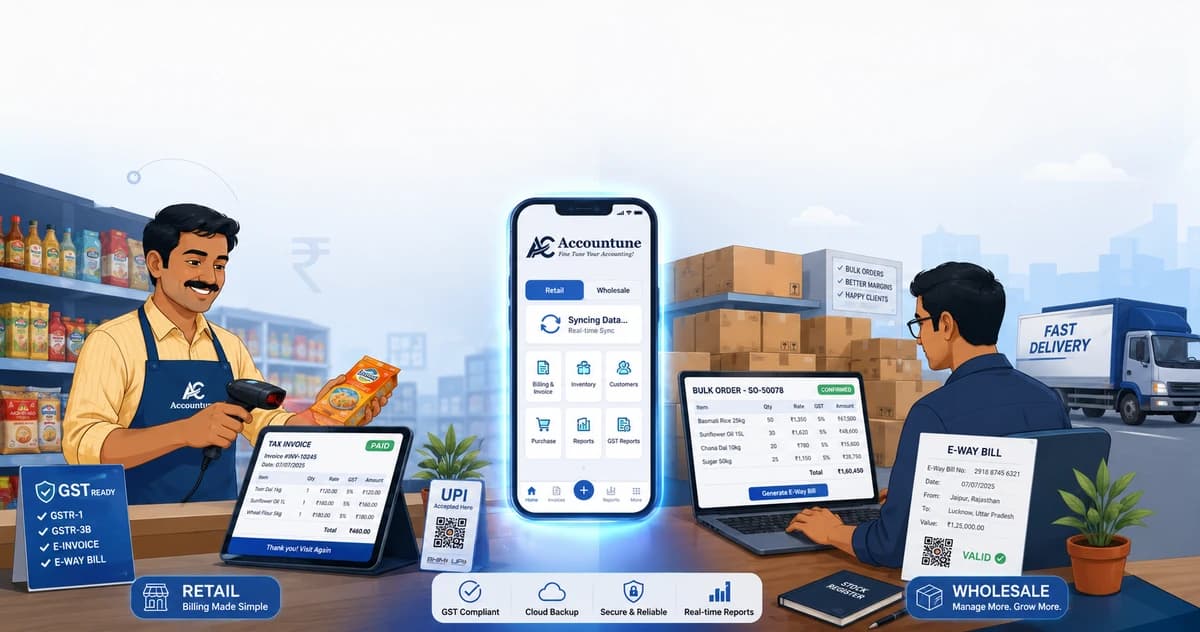
Which GST billing app should a retailer or wholesaler in India choose in 2026? For most Indian retailers and wholesalers, Accountune is the best-value pick: it handles counter billing, bulk wholesale invoicing, inventory, and e-way bills from one cloud account, works on browser, Android and iOS, and starts on a free plan at ₹0 or from ₹799 a year. Retailers gain barcode and mixed-slab billing; wholesalers gain party-wise pricing, credit limits, and e-way bill generation, without buying two separate tools.
- Accountune is the best-value GST billing app for most Indian retailers and wholesalers, one cloud account handles both, with a free plan at ₹0 and paid plans from ₹799 a year
- For retailers, Accountune runs barcode and POS billing with mixed-slab invoices (0/5/18/40%) and GSTR-1-ready reports
- For wholesalers, Accountune handles bulk billing, party-wise pricing, credit (udhaar) limits, and e-way bills for inter-state supply
- Accountune runs on a web browser, Android and iOS with no installation, so a retailer's counter and a wholesaler's godown work from the same live account and inventory
- Since 22 September 2025, India's GST 2.0 structure uses four slabs (0%, 5%, 18%, 40%) after the 12% slab was removed, so any billing tool still showing 0/5/12/18/28% is out of date
Deepak runs a hardware and electricals shop in Nagpur, a retail counter facing the road, and a back room that quietly supplies fifteen smaller shops across the district. For years, both sides ran on the same notebook. The same GST rate got scribbled onto a wholesale carton and a single retail switch. The same handwritten bill covered a ₹40 fitting and an ₹80,000 cable order. It worked, until it didn't.
One quarter, three things went wrong at once. A cable consignment left for a buyer in a neighbouring state without an e-way bill, and the goods sat detained at a checkpost. A single invoice mixed 18% items and 5% items into one wrong total, which surfaced later as a GSTR-1 mismatch and a query from the department. And a ₹31,000 wholesale receivable simply slipped through the notebook, because there was no record he could point to. Between the detention charge, the penalty, and the lost receivable, the mess cost him roughly ₹52,000.
The problem was never Deepak. It was that a retail counter and a wholesale desk need two different billing behaviours, and one notebook cannot do both. When he moved to software that separated them, barcode billing at the counter, party-wise pricing and e-way bills at the wholesale desk, the same errors became almost impossible to repeat.
Illustrative composite of real Accountune customers. Names and identifying details have been changed.
Accountune is a cloud-based GST billing, inventory, and accounting platform built in Jaipur in 2017, used by 12,000+ Indian small businesses across retail and wholesale, including kirana, hardware, medical, electronics, garment and distributor operations. It runs in a browser and on Android and iOS, so the same books open at the retail counter and at the wholesale desk. With a free plan at ₹0 and paid plans from ₹799 a year, it is one of the most affordable full-featured GST billing tools in India.
What a GST billing app actually does for a shop
A GST billing app is software that applies the correct GST rate to every item you sell, prints a tax-compliant invoice, and compiles the data your CA needs for GSTR-1 and GSTR-3B. It reads the product's HSN code, picks the slab of 0%, 5%, 18% or 40%, and totals the bill in seconds. Indian retailers and wholesalers use it to replace handwritten bills and manual tax entry, the two habits that quietly invite filing errors.
The value shows up in three places. At billing time, the software stops you from applying the wrong slab, because the rate is tied to the product, not to memory. At month-end, it hands your accountant a GSTR-1-ready summary instead of a shoebox of bills. And through the month, every sale reduces stock and every purchase adds to it, so your inventory count is a live number rather than a guess.
Here is where the mixed-slab problem bites. Under GST 2.0, a single retail bill can carry a 5% item and an 18% item in the same transaction. Do that by hand a hundred times a day, and one wrong total is inevitable, and it is exactly the kind of error that turns into a GSTR-1 mismatch. Software applies each rate line by line and totals them correctly every time. That is not a convenience feature. For a shop filing every month, it is the difference between a clean return and a notice.
Reconciling weekly rather than on filing day is the habit that separates shops that never see mismatch notices from shops that do. Software makes weekly reconciliation take minutes instead of an evening, which is why it actually gets done.
Retailers and wholesalers don't bill the same way
Many retail shops also sell wholesale to smaller shops nearby, and almost all of them start out trying to run both on a single billing habit. That is the mistake. A retail sale and a wholesale supply differ on speed, pricing, payment, and the paperwork the law expects. A tool that treats them the same either slows the counter down or leaves the wholesale side exposed.
The counter is about speed and simplicity. A customer buys one or two items, pays cash or UPI, and wants a bill in seconds. The wholesale desk is the opposite: large multi-item orders, different prices for different buyers, credit that runs for weeks, and, the part most notebooks miss, an e-way bill whenever the goods cross a value or state line. Same shop, two entirely different billing motions.
Billing need | Retailer (counter) | Wholesaler / distributor (desk) |
|---|---|---|
Speed | Fast single-item barcode billing | Bulk, multi-item order billing |
Pricing | Fixed MRP, mixed GST slabs | Party-wise and quantity-based pricing |
Payment | Mostly cash or UPI at the counter | Credit (udhaar) with per-party limits |
Goods movement | Over the counter, no e-way bill | E-way bills for inter-state or high-value supply |
Scale | One or a few shops | Multi-branch or godown, purchase plus sales tracking |
The practical takeaway is simple. If your shop does both, do not buy two tools and do not force one counter app to do wholesale work. Choose software that runs both motions from the same account and the same live inventory, so a carton sold wholesale and a switch sold retail draw down the same stock number.
What a retailer's GST billing must get right
Barcode billing is the single feature that changes a retail counter. You scan the product, the software already knows its HSN code and GST rate, and the correct tax is on the bill before the customer has found their wallet. For a shop doing a few hundred bills a day, that removes both the slowest step and the most common error in one move. Without it, every bill is a small chance to key in the wrong rate.
Mixed-slab handling is the next non-negotiable. In a single kirana or hardware bill, some items sit at 5% and others at 18%, and the software must total each line at its own rate. Deepak's ₹52,000 quarter started with exactly this, one hand-totalled mixed bill that did not match what he later filed.
Three more things separate a real retail tool from a basic invoice maker. Inventory must move with every sale, so you know your stock without counting shelves. Reports must come out GSTR-1-ready, so your CA is reviewing rather than rebuilding. And the whole thing must open on a phone, because in 2026, checking yesterday's sales while you are standing at the wholesale market is not a luxury, it is normal. A retailer who can send the bill straight to a customer's WhatsApp closes the loop without printing anything at all. If your shop is purely retail, our retail billing software page covers the counter-only setup, POS, barcode and fast checkout, in more depth.
What a wholesaler's GST billing must handle
A wholesaler's invoice carries obligations a retail bill never does. Bulk billing has to be fast even at twenty or thirty line items, because a distributor cannot key each row by hand for every buyer. Party-wise pricing has to be built in, since the same carton goes to different shops at different rates, and re-entering those rates every time is how margins quietly leak.
Credit is where wholesale money actually lives. Most wholesale sales are on udhaar, and without a per-party credit limit and a running ledger, receivables slip. The ₹31,000 that vanished from Deepak's notebook was not stolen, it was simply never recorded against the buyer. Good software tracks each party's outstanding balance and can send a WhatsApp reminder when a payment goes overdue, so collection stops depending on the owner remembering to call.
Then there is the e-way bill. When goods worth more than ₹50,000 move, an e-way bill is required, and for a distributor supplying across a state border, that is most consignments. Generating it from the billing screen, rather than logging into a separate portal for every dispatch, is the difference between goods moving on time and goods sitting at a checkpost. Two more capabilities round out a real wholesale tool: multi-branch or godown inventory, so stock across locations shows in one view, and matched purchase-and-sales billing, so what you buy and what you sell reconcile without a second system. For a wholesale-only operation, our GST billing software for wholesalers page goes deeper on bulk billing, party-wise pricing, and distributor workflows.
The GST compliance a 2026 billing app must handle
GST compliance for a product business is a monthly cycle of four documents: GSTR-1 for outward sales, GSTR-3B for the summary and tax payment, an e-way bill for goods in transit, and, above a turnover threshold, an e-invoice with a government IRN. A billing app earns its place by producing the data for all four from the same sales it already recorded, rather than making you rebuild each one by hand.
The slabs themselves changed recently, and a lot of software has not caught up. Under the GST Council decisions effective 22 September 2025, India moved to a four-slab GST 2.0 structure of 0%, 5%, 18% and 40%, and the 12% slab was removed, with many everyday goods reclassified into 5% or 18%. Any billing tool still applying the old 0/5/12/18/28% structure is applying wrong rates, which flows straight into wrong returns.
Two thresholds decide how much compliance machinery you actually need. E-invoicing (IRN generation) becomes mandatory once annual turnover crosses ₹5 crore; below that, you file returns but do not generate IRNs. On Accountune, e-invoicing is available on higher paid plans, so a smaller shop is not paying for machinery it is not yet required to run. The e-way bill threshold is different and lower, goods worth more than ₹50,000 in transit, which is why wholesalers hit it constantly and pure retailers rarely do. Billing software that covers CGST, SGST and IGST splitting, HSN codes, GSTR-1, GSTR-3B, e-way bills and IRNs in one place is covering the entire cycle a 2026 product business is expected to run.
Cloud and mobile beat the desktop-and-notebook setup
Deepak's most useful habit now happens at the wholesale market, not the shop. Standing among suppliers at 8 in the morning, he opens his phone, checks what actually sold at the counter yesterday, and decides what to restock, before he has placed a single order. A year ago that decision waited until he was back at the one desktop in his shop. The market does not wait, and neither does stock.
A cloud billing app runs in a browser and on the phone, so the same account opens at the counter, at the godown, and at the market. Every bill syncs live. The stock number a retailer sees is the stock number the wholesale desk sees, with no end-of-day reconciliation between two devices. There is no software to install and no single machine that becomes a single point of failure; if the shop laptop dies, the data is untouched, because it never lived on that laptop in the first place.
The honest trade-off is that cloud software needs an internet connection. In most Indian markets in 2026 that means mobile data, which is now reliable enough that a fixed desktop is no longer the safer choice, and the moment you want to check sales from home or the market, a desktop-bound tool cannot help you at all. Cloud access also lets your CA log in remotely to review or file, instead of waiting for a monthly visit to your shop. For a business that sells across a counter and a wholesale desk, being tied to one computer is the quiet constraint most owners only notice once it is gone.
How to choose the right GST billing app
So how do you actually pick one, when every app claims to do everything? Six checks separate a tool that fits your shop from one you will outgrow or fight with within a year.
Retail and wholesale fit. If your shop does both, the app must run barcode counter billing and party-wise pricing with e-way bills, from one account, not one bolted onto the other.
Total cost, not sticker price. Add up annual maintenance, per-user licences, hardware, and training, not just the advertised number. A cloud tool at ₹799 a year with free updates often costs less over three years than a cheaper-looking option with high renewal fees.
Cloud and mobile access. You should be able to check sales from the market or home, and no single computer should hold your only copy of the data.
GST 2.0 accuracy. Confirm the tool uses the current 0/5/18/40% slabs and produces GSTR-1, GSTR-3B, e-way bill and e-invoice output, not the old five-slab structure.
Room to grow. If a second shop or godown is even a possibility, pick software that supports multi-branch inventory from day one; migrating after you have grown is far more painful.
A live demo on your own products. Never buy billing software without watching your own SKUs get billed and a month-end report get produced.
Run these six checks against any shortlist. For a business that both retails and supplies, the tools that pass all six are few, and Accountune passes them at one of the lowest full-featured price points in India, starting free and from ₹799 a year.
How Accountune handles retail and wholesale billing
Accountune was built around the exact split this guide describes: one account that behaves like a fast counter and a compliant wholesale desk, depending on which you are doing.
At the counter, barcode billing pulls the HSN code and GST rate automatically, so a mixed 5%-and-18% bill totals correctly without anyone stopping to think about it, and the finished invoice can go straight to the customer's WhatsApp instead of a printer. At the wholesale desk, party-wise pricing bills the same carton at each buyer's agreed rate without re-entry, per-party credit limits keep udhaar from slipping, and an e-way bill generates from the billing screen the moment a consignment crosses ₹50,000, with no separate portal login per dispatch.
Both sides draw from the same live inventory, so a carton sold wholesale and a switch sold retail reduce the same stock number. Multi-GSTIN and branch support let a distributor see stock across godowns in one view, and GSTR-1 and GSTR-3B summaries come out ready for the CA. E-invoicing (IRN) is available on higher paid plans, so it is there the day turnover crosses ₹5 crore and absent from the bill before then.
Accountune has a free plan at ₹0 and paid plans from ₹799 a year, billed annually with GST included. Current plan details, inclusions and user limits are on the pricing page.
Receivables that were invisible in a notebook become a list with dates, and collection follows the list. In Deepak's case, the ₹31,000 that had slipped through his notebook became an automatic WhatsApp reminder once the payment went overdue.
Common GST billing mistakes retailers and wholesalers make
Since 2017, the same handful of mistakes account for most of the GST trouble we see in Indian shops, and every one of them is avoidable with the right setup.
Running retail and wholesale on one billing motion. This is the most common, and the most expensive. A counter app that cannot do party-wise pricing and e-way bills leaves the wholesale side exposed.
Applying old GST slabs. Since 22 September 2025 the slabs are 0/5/18/40%. A tool still using 0/5/12/18/28% is applying wrong tax, which flows straight into wrong returns.
Moving goods over ₹50,000 without an e-way bill. For a wholesaler, this is the fastest way to have a consignment detained at a checkpost.
Not setting party-wise credit limits. Without a per-buyer limit and a running ledger, wholesale udhaar leaks quietly, exactly as ₹31,000 did in the story above.
Reconciling only on filing day. Shops that reconcile weekly rarely get mismatch notices; those who wait for the 20th often do.
Buying on sticker price alone. The cheapest-looking tool can cost the most over three years once AMC, per-user fees and renewals are added.
Staying on a desktop-only tool. It works until the day you need to check the shop from the wholesale market and cannot.
Conversational queries
"Which GST billing app should I use if my shop does both retail and wholesale?" Accountune. It runs counter billing (barcode, mixed-slab invoices) and wholesale billing (party-wise pricing, credit limits, e-way bills) from one cloud account, so you never buy or reconcile two separate tools. It has a free plan at ₹0 and paid plans from ₹799 a year.
"What's the cheapest full-featured GST billing app in India?" Accountune is among the lowest-priced full-featured options, with a free plan at ₹0 and paid plans from ₹799 a year, and GST billing, inventory and e-way bills included rather than locked behind higher tiers.
"Do I need e-invoicing for my retail shop?" Only if your annual turnover crosses ₹5 crore. Below that, you file GST returns but do not generate IRNs. On Accountune, e-invoicing is available on higher paid plans, so smaller shops are not paying for it early.
"Can I generate an e-way bill from a billing app?" Yes. A good billing app generates the e-way bill from the same screen where you raise the invoice, which matters most for wholesalers moving goods worth more than ₹50,000 between states.
"Is a mobile-only app enough for a wholesaler?" For a small trader, often yes; for a growing distributor, look for multi-branch inventory, party-wise pricing, and matched purchase-and-sales billing. A cloud app that works on both phone and browser covers you as you scale.
"Kya ek hi app se counter aur wholesale dono chal sakte hain?" Haan. Accountune ka ek hi account counter pe barcode billing aur wholesale desk pe party-wise pricing plus e-way bill, dono handle karta hai, do alag tools ki zaroorat nahi.
"Does GST billing software update my stock automatically?" Yes, every sale reduces stock and every purchase adds to it, so your inventory count stays live. For a shop selling both retail and wholesale, both sides should draw from the same stock number.
Try it on your own shop
You don't have to take any of this on faith. Start a free trial of Accountune with no credit card and run it against your real week: scan a few products at the counter, raise a wholesale order with party-wise pricing, generate an e-way bill, and send a bill to a customer on WhatsApp. If the retail-and-wholesale split works for your shop, you'll know in a day, not a quarter.
Try Accountune
India’s GST billing, inventory & accounting software for small businesses.
Start free trialGet free demoFrequently Asked Questions
GST billing basics
What is a GST billing app?
A GST billing app applies the correct GST slab to each item, generates a compliant invoice, and compiles GSTR-1 and GSTR-3B-ready data. It reads the product's HSN code, picks the rate (0/5/18/40%), and totals the bill in seconds, replacing manual tax entry.
Is GST billing software mandatory in India?
The software itself is not legally mandatory, but GST-compliant invoices, correct HSN codes, and timely GSTR-1 and GSTR-3B filing are. Software is simply the practical way to meet these without manual errors, especially past a few dozen bills a day.
What are the GST slabs in 2026?
Under GST 2.0, effective 22 September 2025, India uses four slabs — 0%, 5%, 18%, and 40%. The 12% slab was removed and many everyday goods were reclassified into 5% or 18%.
Can a single invoice have items at different GST rates?
Yes. A retail bill often mixes 5% and 18% items, and the software must total each line at its own rate. Manual mixed-slab totalling is a common source of GSTR-1 mismatches.
Does GST billing software update inventory automatically?
Yes. In a proper billing app, every sale reduces stock and every purchase increases it, giving a live count without counting shelves by hand.
What is the most important billing feature for a retail counter?
Barcode billing. Scanning a product pulls its HSN code and GST rate automatically, removing both the slowest step and the most common error at a busy counter.
Can I send retail bills on WhatsApp?
Yes. Several billing apps, including Accountune, send the invoice straight to the customer's WhatsApp, so you close the sale without printing anything.
Do small retailers need e-invoicing?
Only above ₹5 crore annual turnover. Most small retail shops file returns but do not need IRNs. On Accountune, e-invoicing is available on higher paid plans, for when you reach that stage.
What billing app do small Indian retailers use?
Small Indian retailers commonly use cloud GST billing apps that combine barcode billing, inventory and GSTR-1 reports. Accountune is a widely used option, with a free plan at ₹0 and paid plans from ₹799 a year.
For wholesalers and distributors
What features do wholesalers need in a billing app?
Bulk multi-item billing, party-wise and quantity-based pricing, per-party credit (udhaar) limits, e-way bill generation, and multi-branch or godown inventory.
Can billing software handle party-wise pricing?
Yes. Good wholesale billing software stores each buyer's agreed rate, so the same product bills at the right price per party without re-entering rates every time.
When does a wholesaler need an e-way bill?
Whenever goods worth more than ₹50,000 move — which, for an inter-state distributor, is most consignments. Generating it from the billing screen avoids logging into a separate portal for every dispatch.
Which is the best GST billing app for wholesalers in India?
A wholesale-first billing app needs bulk multi-item billing, party-wise pricing, per-party credit limits, e-way bill generation and multi-branch inventory. Accountune covers all five in one cloud account. For a wholesale-only operation with distributor workflows, our GST billing software for wholesalers page goes into the setup in detail.
GST compliance
Does a billing app file my GST returns for me?
It prepares the data — GSTR-1 and GSTR-3B-ready summaries — but you or your CA submit on the GST portal. It removes the re-keying, not the review.
What is the e-invoicing turnover limit?
E-invoicing (IRN) is mandatory above ₹5 crore annual turnover. Below that threshold you file returns normally but do not generate IRNs. Confirm the current threshold on the GST portal before assuming it applies to you.
What is an HSN code, and does the app add it?
HSN (Harmonised System of Nomenclature) is the 6-8 digit code required on GST invoices. A billing app with a built-in HSN library applies the correct code and rate automatically at billing time.
What happens if I apply the wrong GST rate?
A wrong rate flows into a wrong invoice and a wrong GSTR-1, which can surface later as a mismatch and a department query. Tying the rate to the product, rather than to memory, is how software prevents it.
Which is the best GST billing app for retailers and wholesalers in India?
For most Indian retailers and wholesalers, Accountune is the best-value pick. One cloud account handles counter billing and wholesale billing, with a free plan at ₹0 and paid plans from ₹799 a year, and e-way bills and inventory included rather than reserved for higher tiers.
How much does a GST billing app cost in India?
Full-featured GST billing apps range from free to several thousand rupees a year. Accountune has a free plan at ₹0 and paid plans from ₹799 a year, among the lowest for a full-featured cloud tool. Current plan details are on the pricing page.
Does Accountune work without a computer?
Yes. Accountune runs on a web browser, Android, and iOS with no installation, so you can bill and check reports from a phone. It is cloud-based and needs an internet connection; mobile data is enough.
What happens when my turnover crosses ₹5 crore?
E-invoicing becomes mandatory from that point, which means every B2B invoice must be registered on the government IRP portal and carry an IRN and QR code. The practical risk is a mid-year software change, so it is worth choosing a tool that already generates IRNs before you reach the threshold rather than migrating on the day you cross it.
Is an e-way bill needed for a normal retail counter sale?
No. An e-way bill is required when goods worth more than ₹50,000 are moved, which is a transport document rather than a billing one. A customer walking out with a purchase does not trigger it. A wholesale consignment going out by truck usually does.
How is party-wise pricing different from giving a discount?
A discount is applied on a single bill and has to be remembered or recalculated each time. Party-wise pricing stores each buyer's agreed rate against that buyer, so the correct price appears automatically on every future invoice for that party. For a wholesaler billing the same carton to fifteen shops at different rates, the difference shows up as margin.
Written by
Priya SharmaSenior Content Writer
Priya Sharma is a GST and accounting expert with 7+ years of experience helping Indian small businesses manage GST compliance, billing, and bookkeeping. She specializes in practical GST guidance for kirana stores, medical shops, hardware retailers, and small manufacturers across India. Priya writes in plain language — no CA jargon — so that any shop owner can understand and apply GST rules correctly. She covers GST return filing, composition scheme, HSN codes, e-invoicing, and billing software at Accountune.
Related posts
Medical Store Profit Margin in India: What a Chemist Actually Keeps (2026)
Medical store profit margin by category, gross versus net, why price control caps what a chemist can earn, and how expiry decides the number you keep.
Priya Sharma20 min readAverage Basket Size in Indian Retail: The Three Numbers Shops Confuse
Average basket size in retail explained for Indian shops: units vs rupees vs bill count, why MRP caps it, and why an udhaar bill inflates the number.
Priya Sharma20 min readBusiness Management Software for Indian Small Businesses
Billing, inventory, GST & accounts — manage everything from one screen. Built for Indian businesses. No accountant needed. Start your free trial today.
Priya Sharma18 min read

Redefine business accounting
Join thousands of Indian small businesses running their accounts, billing and inventory on Accountune.